About 95 minutes
Freedom Through Disobedience — A Closer Reading
Democracy Rights
21,652 recorded words. 20 minutes difference from this book's estimate.
View Gutenberg source #35349
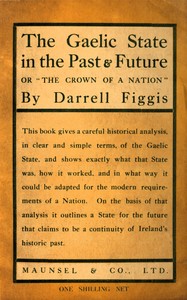
The source record for The Gaelic State in the past & future — A Reader’s Guide measures this digital text at 26,313 words, 1 hr 55 min estimated reading time, and 17 detected text sections.
The text analysis averages about 25.5 words per sentence, while the detected sections provide another way to judge how the source is divided.
Project Gutenberg metadata also associates the work with “Ireland -- Politics and government,” connecting these edition facts with the source record’s subject description.
Explore this collection
These alternatives are selected using recorded categories and estimated reading time.
About 95 minutes
Democracy Rights
21,652 recorded words. 20 minutes difference from this book's estimate.
View Gutenberg source #35349About 91 minutes
Democracy Rights
20,905 recorded words. 24 minutes difference from this book's estimate.
View Gutenberg source #12820About 143 minutes
Democracy Rights
32,702 recorded words. 28 minutes difference from this book's estimate.
View Gutenberg source #40461Search stored excerpts and compare books → Choose by your preferences →
Choices use stored catalog measurements. Estimates vary with reading speed. A shared category is a catalog label, not a claim that two books have the same argument or literary quality.
Search reads excerpt text stored with this catalog and links to its associated Gutenberg record. The connection is stored in the site database; this tool does not recheck that every excerpt is word-for-word identical to that external record. Excerpt search does not cover every chapter and does not verify historical publication dates.
Catalog snapshot checked: 2026-09-26. Coverage: 90 public books, 90 available source excerpts.
Calculated from edition completeness, EPUB availability, text structure and catalogue metadata. Not a user rating.
Total of 100 points, scaled to a 2.5-5.0 range. Editions with an empty description or a missing EPUB file are not scored.
Public-domain source text
The source text is kept in the dedicated reader, separate from this catalogue record and its commentary.
Darrell Figgis opens his 1917 study with a striking metaphor: a nation is only truly crowned when its intuitions and desires are expressed in a state as flexible as its containing life. For Ireland, he contends, the stubborn national sense has long existed as a protest rather than a power. The book sets out to recover the shape of the Gaelic state that was destroyed in 1603, and to ask how its principles might be adapted for modern self-government.
Figgis writes as a participant in the Irish revival, not a detached historian. His analysis is driven by a clear political purpose, yet it rests on a detailed reading of the old polity's structure—its land tenure, its law, its relation between people and ruler. The excerpts show a writer who moves between sharp historical judgment and a visionary, almost poetic, sense of national memory.
One of the most arresting patterns in Figgis's argument is his claim that the nineteenth-century Irish revival moved in reverse chronological order. He writes that the nation had lost, first, its state; then its language and culture; then its land; and finally its liberty of faith. In the resurrection, it won back these losses in the inverse order: first religious liberty, then land, then culture, and now it seeks its state. This is not a casual observation but a structural key to the book. Figgis presents the land war, for instance, not as a modern economic struggle but as the re-assertion of a very old memory—a freeman's right, not a tenant's. He quotes the Devon Commission Digest noting that tenants claimed a tenant-right irrespective of legal claim, and calls this a curious thing to observers with a foreign state-idea. The pattern gives the whole narrative a sense of historical inevitability, as if the nation were a sleeper slowly waking limb by limb.
Figgis is sharply critical of the eighteenth-century Irish Parliament, which he calls the liberty of the English state in Ireland, won by the jailers of the old nation. He describes the Grattan Parliament as an utterly unworkable constitution, because its members remembered the source from which they sprang and would not carry victory to its logical conclusion. The key detail is FitzGibbon's point that the Seal was in the care of the English Chancellor, giving England the final word. Figgis sees this as an independence that needed force at every moment to be of any avail. The Act of Union, in his reading, was England striking down her own jailers and abolishing their little hour of liberty. The parenthesis was concluded, and history could take its course again. This passage reveals Figgis's method: he treats the colonial parliament as a historical dead end, a false dawn that actually delayed the real work of national reconstruction.
Figgis's prose is at its most vivid when he describes the nineteenth century as a haunted hall where ghostly memories become flesh and blood. The image is not decorative; it expresses his core belief that the Irish nation carried within it a living memory of its pre-1603 state, a memory that surfaced in movements like the land war. He notes that the landlordry was now mainly absentee, which made the re-assertion of a freeman's right a solid national act. The language of haunting recurs: the nation arose feebly at first, and marched into the nineteenth century to claim satisfaction for desires and instincts that had never died. This is not a dry constitutional history but a work that blends political analysis with a kind of historical mysticism. Readers should expect a text that is as much about the psychology of national memory as about legal structures.
Figgis's book is best read as a primary document of the Irish revival, not as a neutral history. Its value lies in the way it fuses historical argument with political prophecy. The excerpts suggest a writer who is impatient with compromise and convinced that the Gaelic state offers a template for a just and organic future. Readers interested in the intellectual roots of twentieth-century Irish nationalism will find here a clear, passionate, and structurally inventive case.
Reading Figgis’s account of the Gaelic polity, I keep thinking about how much was lost before anyone thought to write it down. His sense of inverted history lingers. It makes me want to sit quietly with older Irish voices, like the ones in The Prose Works of Jonathan Swift, D.D. - Volume 07 Historical and Political Tracts-Irish — Key Ideas to Explore, where the grievances feel closer to the ground, less abstract, more like weather.
Your answers remain private and are stored only in this browser.