About 143 minutes
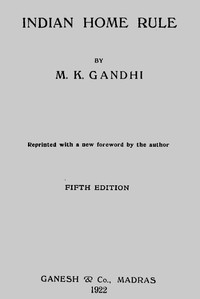
Indian Home Rule — Edition Insights
Democracy Rights
32,702 recorded words. 80 minutes difference from this book's estimate.
View Gutenberg source #40461
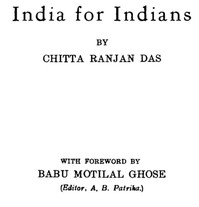
India for Indians Enlarged Edition — Text and Context can be approached with a clearer sense of reading commitment from its source measurements: 51,288 words, 3 hr 43 min estimated reading time, and 5 detected text sections.
The text analysis averages about 20.7 words per sentence, while the detected sections provide another way to judge how the source is divided.
Project Gutenberg metadata also associates the work with “India -- Politics and government -- 1919-1947,” connecting these edition facts with the source record’s subject description.
Explore this collection
These alternatives are selected using recorded categories and estimated reading time.
About 143 minutes
Democracy Rights
32,702 recorded words. 80 minutes difference from this book's estimate.
View Gutenberg source #40461About 115 minutes
Democracy Rights
26,313 recorded words. 108 minutes difference from this book's estimate.
View Gutenberg source #77101About 342 minutes
Democracy Rights
78,587 recorded words. 119 minutes difference from this book's estimate.
View Gutenberg source #49329Search stored excerpts and compare books → Choose by your preferences →
Choices use stored catalog measurements. Estimates vary with reading speed. A shared category is a catalog label, not a claim that two books have the same argument or literary quality.
Search reads excerpt text stored with this catalog and links to its associated Gutenberg record. The connection is stored in the site database; this tool does not recheck that every excerpt is word-for-word identical to that external record. Excerpt search does not cover every chapter and does not verify historical publication dates.
Catalog snapshot checked: 2026-09-26. Coverage: 90 public books, 90 available source excerpts.
Calculated from edition completeness, EPUB availability, text structure and catalogue metadata. Not a user rating.
Total of 100 points, scaled to a 2.5-5.0 range. Editions with an empty description or a missing EPUB file are not scored.
Public-domain source text
The source text is kept in the dedicated reader, separate from this catalogue record and its commentary.
The foreword by Moti Lal Ghose, editor of the A. B. Patrika, opens not with political argument but with a personal portrait of Das’s father, Bhuban Mohan Das, a Calcutta attorney and journalist “connected also with Bengalee journalism.” This biographical framing—emphasizing the father’s “sincere patriot” character and financial ruin from supporting poorer relatives—establishes Das’s lineage within a specific Bengali professional and reformist milieu. The volume itself collects speeches from 1917–1918, including addresses at Hindu-Mahomedan mass meetings, a Home Rule meeting at Barisal, and a protest against internments. The catalog subject “India – Politics and government – 1919-1947” slightly postdates the speeches’ original delivery, but the content directly addresses the pre-1919 reform debates.
In a speech supporting the Indian Deputation to England (March 1918), Das repeatedly identifies “the Bureaucracy in this country” as the primary impediment to reform. He claims that “within the last 30 years there never has been a reform proposed which had not been opposed and defeated by the Bureaucracy.” To illustrate, he cites Lord Ripon’s local self-government policy, which “although nominally granted to us, was in reality denied to us,” and the separation of executive and judiciary, recommended by “Viceroy after Viceroy” yet blocked. Das’s most pointed example is the Minto-Morley reforms: “something when it left the shores of England, but it became absolutely ridiculous when it got into the hands of the Indian Bureaucracy.” He notes that he himself lacked a vote under that scheme, and that Sir S. P. Sinha, an Executive Council member, was also not a qualified voter. The rhetoric is concrete, naming specific officials and policies, and builds a case that agitation within India is insufficient—hence the need to appeal directly to British authorities across the seas.
The March 1918 meeting at Professor Ramamurti’s Pavilion was called to support an Indian deputation to England, whose members included Lokamanya Bal Gangadhar Tilak, Bebin Chandra Pal, Sarojini Naidu, and others. Das argues that the journey is necessary because “self-government cannot be delayed any longer” and that without it, “the growth of our nationality, and the development of Indian manhood will all be stopped.” He sets a tight timeline: “within one year or two, we must have self-government.” The resolution lists the deputation members by name, and Das asserts they are “in the highest sense the representatives of this country.” The speech frames the deputation as a response to bureaucratic intransigence: “you may agitate as long as you like … but you will not get the Bureaucracy in this country to support you. You must, therefore, go to their masters.” This strategic logic—bypassing local officials for imperial audiences—is a key argumentative move in the collection.
The excerpts reveal a consistent oratorical style: direct address to “Gentlemen,” rhetorical questions (“what are the impediments?”), and repeated audience cues (“hear, hear,” “Shame, shame,” “cheers”). Das uses personal anecdotes, such as telling a high official that the bureaucracy had defeated every reform, and then recounting the official’s challenge and his own reply. The structure is cumulative: each example (Ripon’s reforms, judiciary separation, Morley-Minto) reinforces the central claim. The foreword, by contrast, is more narrative and biographical, detailing Das’s father’s career and his own education at the London Missionary College and Presidency College, Calcutta, before going to England. This juxtaposition of personal history with political argument suggests that the volume aims to present Das as both a product of a particular reformist tradition and a forceful contemporary advocate. The speeches are dated and located, grounding them in specific events and audiences.
Readers should note that the excerpts represent only a portion of the volume’s contents; the table of lists speeches on topics from “Home Rule Meeting at Barisal” to “Non-Co-operation.” The foreword by Ghose provides a contemporary perspective on Das’s background, while the speeches themselves offer a record of nationalist argumentation in the late 1910s. The catalog subject “India – Politics and government – 1919-1947” fits the period of the enlarged edition (1921) but the speeches predate the Montagu-Chelmsford reforms and the Rowlatt Acts, making them valuable for understanding the prelude to those events.
Reading Chiranjan Das’s speeches from 1921, I felt that familiar ache of a people explaining themselves to a distant, unhearing power. It reminded me of Swift’s own weary exasperation with London’s treatment of Ireland, a different accent to the same stubborn complaint. His arguments in The Prose Works of Jonathan Swift, D.D. - Volume 07 Historical and Political Tracts-Irish — Key Ideas to Explore echo strangely across the centuries.
Your answers remain private and are stored only in this browser.