About 115 minutes
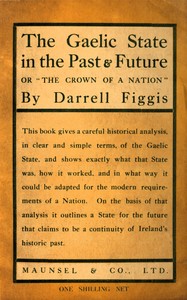
The Gaelic State in the past & future — A Reader’s Guide
Democracy Rights
26,313 recorded words. 28 minutes difference from this book's estimate.
View Gutenberg source #77101
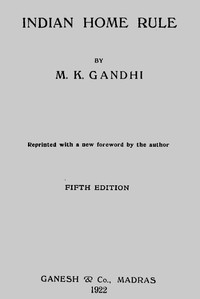
For Indian Home Rule — Edition Insights, the stored edition analysis reports 32,702 words, 2 hr 23 min estimated reading time, and 4 detected text sections.
The text analysis averages about 15.8 words per sentence, while the detected sections provide another way to judge how the source is divided.
Project Gutenberg metadata also associates the work with “India -- Politics and government -- 1919-1947,” connecting these edition facts with the source record’s subject description.
Explore this collection
These alternatives are selected using recorded categories and estimated reading time.
About 115 minutes
Democracy Rights
26,313 recorded words. 28 minutes difference from this book's estimate.
View Gutenberg source #77101About 95 minutes
Democracy Rights
21,652 recorded words. 48 minutes difference from this book's estimate.
View Gutenberg source #35349About 91 minutes
Democracy Rights
20,905 recorded words. 52 minutes difference from this book's estimate.
View Gutenberg source #12820Search stored excerpts and compare books → Choose by your preferences →
Choices use stored catalog measurements. Estimates vary with reading speed. A shared category is a catalog label, not a claim that two books have the same argument or literary quality.
Search reads excerpt text stored with this catalog and links to its associated Gutenberg record. The connection is stored in the site database; this tool does not recheck that every excerpt is word-for-word identical to that external record. Excerpt search does not cover every chapter and does not verify historical publication dates.
Catalog snapshot checked: 2026-09-26. Coverage: 90 public books, 90 available source excerpts.
Calculated from edition completeness, EPUB availability, text structure and catalogue metadata. Not a user rating.
Total of 100 points, scaled to a 2.5-5.0 range. Editions with an empty description or a missing EPUB file are not scored.
Public-domain source text
The source text is kept in the dedicated reader, separate from this catalogue record and its commentary.
Gandhi frames Indian Home Rule as a sustained dialogue between an Editor (himself) and a Reader, a rhetorical choice that lets him anticipate and dismantle objections to nonviolence in real time. The Reader proposes assassination and guerrilla warfare; the Editor counters that such methods would make India unholy and that freedom won by murder cannot bring happiness. This back-and-forth structure, unusual for a political treatise, forces the reader to engage with the logic of violence before Gandhi offers his alternative.
The book opens with a note by C. Rajagopalachar warning that belief in violence, even when not acted upon, disables people from constructive work. This framing sets up the central tension: the work is not merely a rejection of armed struggle but a diagnosis of how the worship of force corrupts all political action.
Gandhi’s choice of the Socratic dialogue is itself an argument. The Reader voices the impatient nationalism of 1909—advocating targeted assassinations and guerrilla war—while the Editor calmly redirects each point toward moral self-examination. When the Reader boasts that the English have been frightened by murders, the Editor replies that what is granted under fear can be retained only so long as the fear lasts, citing the Proclamation of 1857 as evidence. This exchange reveals Gandhi’s method: he does not merely assert nonviolence but demonstrates its strategic superiority by analyzing the psychology of power.
The dialogue also allows Gandhi to distinguish his patriotism from mere anti-colonialism. He states that if an Englishman dedicated his life to serving India, he would welcome that Englishman as an Indian. This move undercuts ethnic nationalism and insists that home rule must mean the welfare of the whole people, not just the transfer of power to Indian hands.
Gandhi repeatedly ties the Reader’s desire for armed struggle to the adoption of European civilization. To arm India on a large scale, he argues, is to Europeanise it, reducing India to the same pitiable condition as Europe. This is a key move: the book is not simply a manual for political independence but a critique of modernity itself. The Reader’s assumption that freedom requires matching British military power is met with the claim that such a path would make India’s condition just as pitiable as that of Europe.
This rejection extends to the very idea of representative government as practiced in the West. Gandhi’s vision of home rule is not parliamentary democracy but swaraj as self-rule—a moral and spiritual transformation of individuals and communities. The excerpts show him insisting that patriotism means resisting tyranny whether it comes from Englishmen or Indian princes, a stance that refuses to romanticize native rule.
The prefatory note by C. Rajagopalachar identifies two classes of people who believe in violence: a small minority who act on it, and a much larger class who, while not acting, are disabled from any constructive work. This second group is Gandhi’s real target. He argues that belief in violence, even when passive, dissuades people from sacrifice and makes them incapable of building a new society. The book thus aims to eradicate the worship of force in all its forms.
Gandhi’s critique is not merely moral but practical. He observes that the English are both a timid and a brave nation, easily influenced by gunpowder, but that fear-based concessions are always temporary. The Proclamation of 1857, granted after a revolt, was toned down once peace returned. This historical example grounds his argument that lasting change requires changing hearts, not just coercing rulers.
Readers should approach Indian Home Rule as a work of political philosophy in dialogue form, not a policy pamphlet. Gandhi’s arguments unfold through the Reader’s objections, so attending to the sequence of exchanges reveals how he builds his case step by step. The book’s power lies less in its conclusions than in the process of reasoning it enacts—a process that demands the reader examine their own assumptions about force, freedom, and the kind of society worth building.
Reading Indian Home Rule brought back sitting on my grandfather’s porch, him arguing that freedom meant little without inner change. He’d have nodded at Gandhi’s moral core. It reminded me, too, of Swift’s quieter fury over Ireland’s wounds—a similar ache for reform. The Prose Works of Jonathan Swift, D.D. - Volume 07 Historical and Political Tracts-Irish — Key Ideas to Explore felt like that, a reflection on a people’s soul rather than just their politics.
Answer a few questions and save a private reflection on this device.