About 46 minutes
Stephen H. Branch's Alligator, Vol. 1 no. 04, May 15, 1858 — A Closer Reading
Government
10,407 recorded words. 0 minutes difference from this book's estimate.
View Gutenberg source #48932
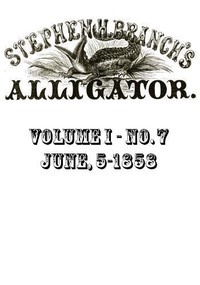
The source record for Stephen H. Branch's Alligator, Vol. 1 no. 07, June 5, 1858 — Inside the Classic measures this digital text at 10,420 words, 46 min estimated reading time, and 1 detected text section.
The text analysis averages about 26.3 words per sentence, while the detected sections provide another way to judge how the source is divided.
Project Gutenberg metadata also associates the work with “New York (N.Y.) -- Politics and government,” connecting these edition facts with the source record’s subject description.
Explore this collection
These alternatives are selected using recorded categories and estimated reading time.
About 46 minutes
Government
10,407 recorded words. 0 minutes difference from this book's estimate.
View Gutenberg source #48932About 47 minutes
Government
10,785 recorded words. 1 minutes difference from this book's estimate.
View Gutenberg source #54834About 47 minutes
Government
10,707 recorded words. 1 minutes difference from this book's estimate.
View Gutenberg source #54877Search stored excerpts and compare books → Choose by your preferences →
Choices use stored catalog measurements. Estimates vary with reading speed. A shared category is a catalog label, not a claim that two books have the same argument or literary quality.
Search reads excerpt text stored with this catalog and links to its associated Gutenberg record. The connection is stored in the site database; this tool does not recheck that every excerpt is word-for-word identical to that external record. Excerpt search does not cover every chapter and does not verify historical publication dates.
Catalog snapshot checked: 2026-09-26. Coverage: 90 public books, 90 available source excerpts.
Calculated from edition completeness, EPUB availability, text structure and catalogue metadata. Not a user rating.
Total of 100 points, scaled to a 2.5-5.0 range. Editions with an empty description or a missing EPUB file are not scored.
PETER COOPER’S AVARICE AND INFERNAL ANTECEDENTS. 8
THE EARLY PENURY OF THE THREE NAPOLEONS OF THE AMERICAN PRESS—BENNETT, GREELEY, AND RAYMOND. 11
Volume I.—No. 7.] SATURDAY, JUNE 5, 1858. [Price 2 Cents.
Entered according to Act of Congress, in the year 1857, by
In the Clerk’s Office of the District Court of the United States for the Southern District of New York.
Life of Stephen H. Branch.
Stephen H. Branch’s Alligator of June 5, 1858, opens not with news but with a first-person memoir. Branch recounts his courtship and marriage in Providence, describing a persistent suitor who “would often be prancing towards me like an Arabian courser.” The personal tone immediately signals that this paper will blend autobiography with political attack. The issue’s contents list promises three main pieces: a life of Branch, an exposé of Peter Cooper, and a sketch of the early poverty of editors Bennett, Greeley, and Raymond. A first reader should note how Branch uses his own story as a credential before turning his pen on others.
The lead article, “Life of Stephen H. Branch,” occupies the first pages. Branch describes his courtship in detail: the girl’s family favored the match, and he married her in a “large and magnificent” wedding. He then lost a clerkship due to the “commercial desolation of 1837.” This personal history does more than entertain; it establishes Branch as a man of sentiment and experience, someone who has known both love and economic hardship. By placing his own life first, Branch claims authority to judge others. The reader should watch how this autobiographical frame recurs—or does not—in later issues.
The second article, “Peter Cooper’s Avarice and Infernal Antecedents,” is a sustained polemic. Branch calls Cooper a “cunning old rat” who cheated the Common Council and mistreats his workers. He accuses Cooper of dragging an “inoffensive apple-woman” by the throat and throwing her into the gutter. The language is visceral: Cooper “must soon meet his plundered aunt in the realms of shadows.” Branch piles specific allegations—tax reductions, nepotism, low wages—without offering evidence from outside his own assertion. A first reader should note the rhetorical strategy: Branch uses vivid, morally charged anecdotes to damn his target, and the lack of external sources is itself a feature of this style.
The third article recounts the early poverty of James Gordon Bennett, Horace Greeley, and Henry J. Raymond. Branch quotes Congressman John Kelly, who says he was Bennett’s first employee, a “poor, barefooted boy” who swept the office. Bennett’s first Herald office was a basement in a “dilapidated building” for which he paid no rent. The piece aims to humble the powerful editors by contrasting their current success with their penniless starts. Branch’s sources are oral—Kelly’s testimony—and the tone is admiring rather than hostile. This section shows Branch can praise as well as condemn, and it suggests his network of informants among New York’s political class.
The three main articles are not separated by clear editorial framing; they simply follow one another. Branch’s voice remains consistent: first-person, opinionated, and conversational. He uses exclamation points, rhetorical questions, and direct address. The paper’s title, Alligator, hints at a snapping, aggressive stance. A first reader should pay attention to how Branch shifts between autobiography, invective, and historical sketch without transition. This structure suggests the paper was written quickly, perhaps to fill space, and that Branch expected his audience to follow his leaps. The lack of a unifying editorial statement leaves the reader to infer the connections.
Reading this issue of the Alligator requires adjusting to Branch’s personal, combative style. He offers no pretense of objectivity; his evidence is anecdotal and his judgments absolute. The excerpts give a clear sense of his methods: autobiographical credentialing, moral outrage, and oral testimony. A first-time reader should treat each claim as a product of Branch’s agenda, not as verified fact. The value lies in what the paper reveals about mid-nineteenth-century New York’s political culture—its feuds, its press, and its willingness to print personal attacks under the banner of reform.
Reading Branch’s bitterness toward Peter Cooper, I kept thinking how strange it is that even the ugliest grudges preserve a voice so vividly. It almost felt like flipping through A Letter Addressed to the Abbe Raynal, where anger at a distant critic still carries a man’s quiet pride. Old arguments make ghosts feel present, don’t they? A Letter Addressed to the Abbe Raynal, on the Affairs of North America, in Which the Mistakes in the Abbe's Account of the Revolution of America Are Corrected and Cleared — A Reader’s Guide holds that same brittle warmth. I closed the page feeling oddly grateful for their noise.
Save your reaction, strongest insight, and memorable passage.