About 340 minutes
Practical Politics; or, the Liberalism of To-day — Edition Insights
Government
78,190 recorded words. 1 minutes difference from this book's estimate.
View Gutenberg source #35894
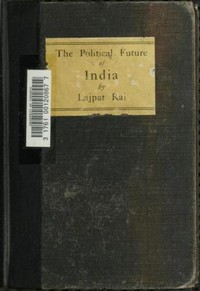
The source record for The Political Future of India — Story, Setting & Ideas measures this digital text at 78,338 words, 5 hr 41 min estimated reading time, and 10 detected text sections.
The text analysis averages about 25.5 words per sentence, while the detected sections provide another way to judge how the source is divided.
Project Gutenberg metadata also associates the work with “India -- Politics and government -- 1765-1947,” connecting these edition facts with the source record’s subject description.
Explore this collection
These alternatives are selected using recorded categories and estimated reading time.
About 340 minutes
Government
78,190 recorded words. 1 minutes difference from this book's estimate.
View Gutenberg source #35894About 340 minutes
Government
78,098 recorded words. 1 minutes difference from this book's estimate.
View Gutenberg source #40350About 348 minutes
Government
79,887 recorded words. 7 minutes difference from this book's estimate.
View Gutenberg source #13943Search stored excerpts and compare books → Choose by your preferences →
Choices use stored catalog measurements. Estimates vary with reading speed. A shared category is a catalog label, not a claim that two books have the same argument or literary quality.
Search reads excerpt text stored with this catalog and links to its associated Gutenberg record. The connection is stored in the site database; this tool does not recheck that every excerpt is word-for-word identical to that external record. Excerpt search does not cover every chapter and does not verify historical publication dates.
Catalog snapshot checked: 2026-09-26. Coverage: 90 public books, 90 available source excerpts.
Calculated from edition completeness, EPUB availability, text structure and catalogue metadata. Not a user rating.
Total of 100 points, scaled to a 2.5-5.0 range. Editions with an empty description or a missing EPUB file are not scored.
Public-domain source text
The source text is kept in the dedicated reader, separate from this catalogue record and its commentary.
Lajpat Rai opens The Political Future of India by contrasting India's wartime sacrifice—raising an army of over a million combatants and losing six million to influenza—with the British claim that such effort proved satisfaction with British rule. He insists that India's dissatisfaction is well documented, citing reports and speeches. This tension between imperial narrative and Indian reality frames the entire work.
Rai, a prominent nationalist and former president of the Indian National Congress, wrote this book in 1919, the same year the Montagu-Chelmsford Reforms were enacted. The excerpts focus on the proposed dyarchy system: dividing provincial subjects into 'reserved' (controlled by the Governor) and 'transferred' (handled by Indian ministers). Rai dissects the mechanics of these reforms, questioning whether they genuinely advance self-government or merely entrench British authority.
Rai begins by quantifying India's contribution to the First World War: over a million combatants, huge supplies of money and materials, and the loss of six million lives to influenza. He notes that Britain interpreted this as voluntary and as evidence of satisfaction with British rule. But Rai counters by pointing to the 'writings and utterances of her representative spokesman' and the reports of the Secretary of State and Viceroy, which he says establish dissatisfaction 'beyond the possibility of doubt.' The passage reveals a central rhetorical strategy: Rai uses British sources to undermine British claims. He does not deny Indian loyalty but reframes it as 'self-effacement in the interests of an Empire which, in the past, had treated her children as helots.' This sets up a moral ledger—India's sacrifice demands political repayment.
The excerpts include lengthy passages from the Montagu-Chelmsford Report, outlining the proposed provincial governance structure. Key features include: a Governor who can certify a bill as 'of such a nature that its enactment is essential,' allowing it to pass automatically after a time limit; a budget where reserved subjects have priority and the Governor can insist on allotments; and a review after five years where the Government of India may transfer subjects between reserved and transferred lists. Rai presents these provisions without explicit commentary in the excerpts, but the dry, procedural language itself suggests a system designed to limit Indian control. The Governor retains ultimate authority over finance and legislation, while ministers' salaries can be made subject to council vote only at the discretion of higher authorities. The 'periodic commissions' clause—a review after ten years—further delays full responsible government.
Throughout the excerpts, Rai juxtaposes Indian expectations with British safeguards. The reforms promise 'transferred subjects' under Indian ministers, but the Governor's power to certify bills and control budgets hollows out that responsibility. Rai's preface frames the book as a response to the gap between British rhetoric and structural reality. He notes that his earlier work, Young India, predicted a 'bitter and sustained' struggle after the war. The excerpts do not reveal Rai's own proposed alternative, but his method is clear: he lets the reforms' own language expose their limitations. The reader is left to weigh whether the scheme is a genuine step toward self-government or a mechanism to preserve imperial control under a democratic facade. Rai's tone is measured, but his selection of details—the Governor's veto, the five-year review, the priority of reserved subjects—builds a case for skepticism.
Readers should approach The Political Future of India as a primary source from a pivotal moment: the aftermath of World War I and the introduction of limited self-government in British India. Rai's analysis is both a critique of the Montagu-Chelmsford Reforms and a window into nationalist thinking of the era. Pay attention to how he uses official documents and statistics to challenge imperial narratives. The book rewards careful reading of its procedural details, which reveal the precise mechanisms of power that Rai sought to expose.
Reading Lajpat Rai’s measured worry about which powers stay reserved and which become transferred, I remembered sitting on my grandfather’s porch with The Swiss Republic — Inside the Classic, marveling at how a small country trusted its cantons so lightly, while Rai’s India seemed trapped in suspicion. Both books made me feel the same quiet ache—governance is just people deciding how much to let go.
Answer a few questions and save a private reflection on this device.