About 736 minutes
The Middle Period, 1817-1858 — Background and Themes
Government
169,115 recorded words. 17 minutes difference from this book's estimate.
View Gutenberg source #35558
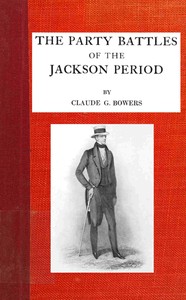
The source record for The party battles of the Jackson period — Text and Context measures this digital text at 173,103 words, 12 hr 33 min estimated reading time, and 30 detected text sections.
The text analysis averages about 21.3 words per sentence, while the detected sections provide another way to judge how the source is divided.
Project Gutenberg metadata also associates the work with “Jackson, Andrew, 1767-1845,” connecting these edition facts with the source record’s subject description.
Explore this collection
These alternatives are selected using recorded categories and estimated reading time.
About 736 minutes
Government
169,115 recorded words. 17 minutes difference from this book's estimate.
View Gutenberg source #35558About 707 minutes
Government
162,571 recorded words. 46 minutes difference from this book's estimate.
View Gutenberg source #52156About 805 minutes
Government
185,097 recorded words. 52 minutes difference from this book's estimate.
View Gutenberg source #7080Search stored excerpts and compare books → Choose by your preferences →
Choices use stored catalog measurements. Estimates vary with reading speed. A shared category is a catalog label, not a claim that two books have the same argument or literary quality.
Search reads excerpt text stored with this catalog and links to its associated Gutenberg record. The connection is stored in the site database; this tool does not recheck that every excerpt is word-for-word identical to that external record. Excerpt search does not cover every chapter and does not verify historical publication dates.
Catalog snapshot checked: 2026-09-26. Coverage: 90 public books, 90 available source excerpts.
Calculated from edition completeness, EPUB availability, text structure and catalogue metadata. Not a user rating.
Total of 100 points, scaled to a 2.5-5.0 range. Editions with an empty description or a missing EPUB file are not scored.
Public-domain source text
The source text is kept in the dedicated reader, separate from this catalogue record and its commentary.
Claude G. Bowers's The Party Battles of the Jackson Period opens with a preface that frames the 1828 campaign as “the rising of the people” and positions Jackson as a crusader for democratic fundamentals. The author’s diction—words like “flaming patriotism” and “robust Americanism”—signals a partisan lens, yet the text also offers granular detail: Calhoun’s warning of “political prostitution” and Webster’s late-night Senate speech, delivered by candlelight, are rendered with theatrical specificity. Bowers draws on letters, such as Jackson’s note that Webster “handled him as a child,” to convey the personal stakes behind policy debates. The narrative voice is vivid, often editorial, but grounded in primary sources like Benton’s memoirs and Lodge’s biography, giving readers a sense of the era’s verbal combat.
Bowers consistently employs martial language to describe political exchanges. Calhoun’s speech threatens “war” and “massacres,” and he declares that enforcement of a bill would be “resisted at every hazard—even that of death itself.” Webster, in turn, is said to “crush” the sophistries of nullification “one by one.” The author’s own prose mirrors this combative tone: Jackson’s opponents are “enemies,” and the Force Bill is a necessary tool against “revolution” and “chaos.” This lexical choice transforms legislative debate into battlefield reportage, emphasizing the high emotional temperature of the era.
Bowers builds character through reported speech and indirect commentary. Jackson is portrayed as anxiously but confidently awaiting news of Webster’s speech, while Calhoun is depicted as “outraged” and later dismissed by Jackson as possibly “in a state of dementation.” Webster’s manner is described as “accustomed gravity” and “more than his usual earnestness,” without passion or personal feeling. The author also notes the physical setting—the “little Senate Chamber” lit by lamps, the densely packed galleries—to underscore the drama. These details, drawn from letters and contemporary accounts, give each figure a distinct rhetorical and emotional profile.
The excerpted text centers on a single, extended confrontation: Calhoun’s speech followed by Webster’s reply. Bowers structures the narrative as a sequence of oratorical performances, with clear before-and-after reactions. He notes that Webster “took the resolutions Calhoun had submitted as embodying his views” and built his argument upon them, avoiding personalities. The aftermath includes Jackson’s personal thanks, Livingston’s appreciation, and overtures to win Webster to the Administration. This tight focus on one debate exemplifies Bowers’s method: using a pivotal event to illuminate broader party dynamics, while relying on eyewitness testimony and correspondence for verisimilitude.
Small, repeated details anchor Bowers’s narrative in the material world. Webster is seen “rolling up to the Capitol in the White House carriage” on a stormy day. The Senate chamber is lit by lamps as the debate extends into evening. Jackson writes to Poinsett with a vivid metaphor about Webster handling Calhoun “as a child.” These concrete images—a carriage, a lamp, a letter—serve as evidence of the author’s reliance on documentary sources and his effort to make abstract political conflict tangible. They also hint at the informal networks (carriage rides, private notes) that shaped public outcomes.
Readers should attend to Bowers’s use of quoted material: he often embeds fragments of speeches and letters without full citation, blending his own voice with historical actors’. The preface’s acknowledgment of a “fairer appraisement” after a century suggests the author’s awareness of his own interpretive stance. For those interested in the rhetoric of American political conflict, this work offers a densely sourced, dramatically charged account of how language and personality drove the battles of the Jackson era.
I keep thinking about how Bowers lets the old speeches breathe, the way Jackson and Calhoun’s words still feel urgent. It reminded me of something humbler, oddly intimate—Stephen H. Branch's Alligator, Vol. 1 no. 13, July 17, 1858 — A Reader’s Guide. Raw, messy, alive. That same electric crackle of people fighting over what America meant, just smaller and stranger. Stayed with me long after.
Build a private reading journal entry for this title.