About 695 minutes
The Swiss Republic — Inside the Classic
Government
159,812 recorded words. 12 minutes difference from this book's estimate.
View Gutenberg source #69971
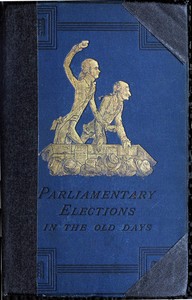
For A History of Parliamentary Elections and Electioneering in the Old Days Showing the State of Political Parties and Party Warfare at the Hustings and in the House of — Text and Context, the stored edition analysis reports 162,571 words, 11 hr 47 min estimated reading time, and 23 detected text sections.
The text analysis averages about 20.9 words per sentence, while the detected sections provide another way to judge how the source is divided.
Project Gutenberg metadata also associates the work with “Great Britain -- Politics and government,” connecting these edition facts with the source record’s subject description.
Explore this collection
These alternatives are selected using recorded categories and estimated reading time.
About 695 minutes
Government
159,812 recorded words. 12 minutes difference from this book's estimate.
View Gutenberg source #69971About 736 minutes
Government
169,115 recorded words. 29 minutes difference from this book's estimate.
View Gutenberg source #35558About 753 minutes
Government
173,103 recorded words. 46 minutes difference from this book's estimate.
View Gutenberg source #72299Search stored excerpts and compare books → Choose by your preferences →
Choices use stored catalog measurements. Estimates vary with reading speed. A shared category is a catalog label, not a claim that two books have the same argument or literary quality.
Search reads excerpt text stored with this catalog and links to its associated Gutenberg record. The connection is stored in the site database; this tool does not recheck that every excerpt is word-for-word identical to that external record. Excerpt search does not cover every chapter and does not verify historical publication dates.
Catalog snapshot checked: 2026-09-26. Coverage: 90 public books, 90 available source excerpts.
Calculated from edition completeness, EPUB availability, text structure and catalogue metadata. Not a user rating.
Total of 100 points, scaled to a 2.5-5.0 range. Editions with an empty description or a missing EPUB file are not scored.
Public-domain source text
The source text is kept in the dedicated reader, separate from this catalogue record and its commentary.
Joseph Grego’s 1886 history examines the mechanics and abuses of British parliamentary elections from the Stuart period through the reign of Queen Victoria, drawing heavily on contemporary political squibs, lampoons, and pictorial satires. The work is less a narrative of legislative reform than a catalogue of corrupt practices—bribery, intimidation, pocket boroughs, and the manipulation of the franchise—illustrated through the visual and verbal ephemera of the time. Grego’s preface frames the subject as a matter of national birthright, arguing that debauched constituencies produce corrupt legislatures, yet he concedes that even basely constituted Parliaments were “on the whole, fairly honest.”
Grego’s method is distinctive: he treats caricatures, squibs, and lampoons not as decorative additions but as primary documents that reveal the temper of electoral contests. The book’s full title promises to show “the state of political parties and party warfare at the hustings” through these materials, and the excerpts confirm that Grego integrates them into his argument. For instance, he quotes a satirical poem by W. M. Praed (1826) that mocks both Tories and Whigs for their venality, and a passage from Lord Byron’s verse that skewers a politician who “held some sinecures he wish’d abolish’d, / But that with them all law would be demolish’d.” These citations are not mere ornaments; they serve as evidence of contemporary attitudes toward corruption. Grego’s earlier works on the caricaturists James Gillray and Thomas Rowlandson suggest he was well positioned to interpret such material, though the excerpts do not detail how he reproduces or analyzes the images themselves.
A substantial portion of the excerpts focuses on the 1770 Westminster election, which followed a period of intense conflict between the Crown and the City of London. Grego recounts how the king prorogued Parliament after it approved addresses that “fortified the royal censure” of popular remonstrances. The citizens of Westminster, however, persisted in petitioning, and Grego praises their eventual success “in spite of the united efforts of the Court, the Ministers, and the Parliament.” He quotes Junius on the metropolis as “the life-blood of the state” and highlights the role of Lord Chatham and William Beckford, whose “firm attitude” is contrasted with the “subservient courtier” that a chief magistrate might become. The election itself is described in procedural detail: electors assembled at the Standard Tavern, processed with music to Sir Robert Bernard’s house, and filled Covent Garden before Sir John Hussey Delaval addressed them. Grego’s account suggests that the remonstrance movement temporarily dampened ministerial ardour, as no Court candidate was put forward in 1770.
While Grego’s preface and selected passages convey a clear moral stance against electoral corruption, the excerpts do not reveal how systematically he documents bribery, intimidation, or boroughmongering across the entire period. The catalog subjects—Great Britain—Politics and government and Great Britain. Parliament—Elections—are broadly consistent with the content, but the excerpts focus heavily on the late eighteenth century, particularly the 1770 Westminster case. The earlier Stuart era and the transition to Victoria are mentioned in the title but not illustrated in the provided text. Grego’s reliance on satirical prints raises questions about representativeness: do the lampoons he reproduces reflect widespread practices or exceptional scandals? The preface’s claim that “bad as were the workings of the electoral system … Parliaments thus basely constituted were, on the whole, fairly honest” introduces a tension that the excerpts do not resolve. Readers should note that the book’s 162,571 words likely cover a broader chronological and thematic range than these samples suggest.
Grego’s history is best approached as a curated gallery of electoral malpractice, animated by the voices of satirists and the actions of civic reformers. The excerpts show a writer who values concrete episodes—the procession to Covent Garden, the king’s prorogation speech, the inscription on Beckford’s monument—over abstract theory. Readers interested in the visual culture of politics will find the promised illustrations essential, though the digital edition may not reproduce them. The work rewards those who read it alongside the caricatures it describes, as Grego’s text often serves as a gloss on the images he collected.
I keep thinking about that old study of elections—how easily voices got bought, how loud the laughter was at the polls. It made me wonder what quiet corners those same people kept. There's something tender in that, the public noise versus a private shelf, like this Arbuthnotiana: The Story of the St. Alb-ns Ghost (1712) A Catalogue of Dr. Arbuthnot's Library (1779) — Background and Themes—a ghost and a catalog, both lingering softly after the shouting dies down.
Answer a few questions and save a private reflection on this device.