About 924 minutes
The Government of England (Vol. I) — Story, Setting & Ideas
Political Thought
212,486 recorded words. 65 minutes difference from this book's estimate.
View Gutenberg source #34471
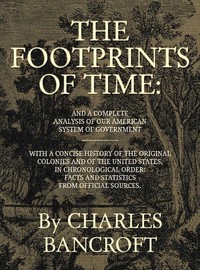
The Footprints of Time And a Complete Analysis of Our American System of Government, with a Concise History of the Original Colonies and of the United States, in — Text and Context can be approached with a clearer sense of reading commitment from its source measurements: 227,347 words, 16 hr 29 min estimated reading time, and 29 detected text sections.
The text analysis averages about 17.6 words per sentence, while the detected sections provide another way to judge how the source is divided.
Project Gutenberg metadata also associates the work with “United States -- Politics and government,” connecting these edition facts with the source record’s subject description.
Explore this collection
These alternatives are selected using recorded categories and estimated reading time.
About 924 minutes
Political Thought
212,486 recorded words. 65 minutes difference from this book's estimate.
View Gutenberg source #34471About 589 minutes
Political Thought
135,397 recorded words. 400 minutes difference from this book's estimate.
View Gutenberg source #34713About 500 minutes
Political Thought
114,871 recorded words. 489 minutes difference from this book's estimate.
View Gutenberg source #10733Search stored excerpts and compare books → Choose by your preferences →
Choices use stored catalog measurements. Estimates vary with reading speed. A shared category is a catalog label, not a claim that two books have the same argument or literary quality.
Search reads excerpt text stored with this catalog and links to its associated Gutenberg record. The connection is stored in the site database; this tool does not recheck that every excerpt is word-for-word identical to that external record. Excerpt search does not cover every chapter and does not verify historical publication dates.
Catalog snapshot checked: 2026-09-26. Coverage: 90 public books, 90 available source excerpts.
Calculated from edition completeness, EPUB availability, text structure and catalogue metadata. Not a user rating.
Total of 100 points, scaled to a 2.5-5.0 range. Editions with an empty description or a missing EPUB file are not scored.
Public-domain source text
The source text is kept in the dedicated reader, separate from this catalogue record and its commentary.
Charles Bancroft's 1875 volume opens with a clear purpose: to supply the means of forming an accurate idea of the American government. The preface announces a dual structure—first tracing 'The Footprints of Time through all history,' then proceeding to a 'close and clear analysis of the whole structure of the government.' This division shapes the reading experience: the early chapters survey ancient republics and the rise of modern civilization, while later sections dissect the Executive, Legislative, and Judicial branches in detail. Bancroft explicitly frames his work as a compilation from official sources, aiming to compress a library into a convenient form. Readers should expect a methodical, fact-driven approach rather than narrative storytelling.
The excerpts show that Bancroft organizes U.S. history by presidential elections, each numbered and described with vote tallies, candidate names, and political context. For example, the Seventeenth Election (1852) notes the 'subject of slavery' absorbing public attention, while the Eighteenth (1856) introduces the Republican party and a third-party 'native Americans' ticket. This pattern—election number, candidates, popular and electoral votes, then commentary—repeats across decades. The effect is a statistical skeleton of political change, where party realignments (like the Whigs becoming extinct) are recorded as matter-of-fact transitions. Readers can use these election summaries as anchor points to track shifting alliances and issues.
Bancroft repeatedly cites 'facts and statistics from official sources,' and the excerpts bear this out. Vote counts are given precisely: for 1852, Pierce's popular vote is 1,590,490 against Scott's 1,378,589; for 1860, Lincoln's electoral count is 180. The author also notes when a candidate wins only a plurality, as with Buchanan in 1856. This quantitative approach extends to the number of states voting (30 in 1848, 31 in 1852 and 1856). The text does not offer dramatic interpretation but lets the numbers speak—for instance, the 1860 election's three Democratic tickets collectively outpolled Lincoln by nearly a million popular votes, yet he won the electoral college. Such data invites readers to draw their own conclusions about democratic representation.
While the historical excerpts focus on elections, the preface promises a second part: a detailed analysis of government 'divisions'—Executive, Legislative, Judicial—with sub-divisions examined 'in detail, but successively.' The author aims to create a 'definite picture' of how each branch operates and relates to others. This structural analysis likely includes explanations of powers, checks and balances, and administrative workings. Readers moving from the historical chapters to this analytical section will find a shift from chronological narrative to systematic description. The preface emphasizes that the book is 'a complete summary, or Citizens’ Manual,' suggesting that the analysis is designed for reference as much as for sequential reading.
Bancroft acknowledges his work is 'indeed a compilation,' with matter drawn from 'an astonishingly large number of books, all of which are not to be found even in the largest public libraries.' This self-description alerts readers that the text synthesizes material rather than presenting original research. The preface claims the labor lies in 'gathering so much from all directions and compressing a library into a form and compass so convenient.' The excerpts confirm this: election data appears standardized, and political commentary is concise. Readers should treat the book as a curated digest of 19th-century official and historical sources, useful for its breadth but not for deep analysis of any single event or figure.
Bancroft's work rewards selective reading: the election-by-election chronicle offers a quick reference for party shifts and vote totals, while the government analysis provides a systematic overview of federal structure. Because the book is a compilation, readers may wish to verify specific claims against primary sources. The author's 1875 perspective—treating the Constitution as the culmination of historical progress—colors the narrative, but the factual data remains a valuable resource for studying 19th-century American political history.
Holding Bancroft’s old pages, I recalled evenings at my grandfather’s desk—his hickory pipe, the taste of paper dust. We never named the machinery of law, only felt its weight. That same grey patience returned with Unpopular government in the United States — Story, Setting & Ideas, where empty chambers breathe a similar hush: not a story told, but a door left ajar, quietly watched.
Build a private reading journal entry for this title.