
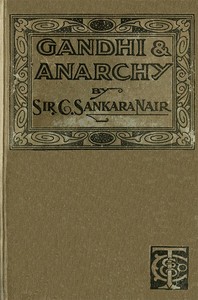
Gandhi and Anarchy — Story, Setting & Ideas
Edition facts
The catalog record for Gandhi and Anarchy — Story, Setting & Ideas provides practical reading context through 69,258 words, 5 hr 2 min estimated reading time, and 9 detected text sections.
The text analysis averages about 22.5 words per sentence, while the detected sections provide another way to judge how the source is divided.
Project Gutenberg metadata also associates the work with “India -- Politics and government -- 1919-1947,” connecting these edition facts with the source record’s subject description.
Calculated from edition completeness, EPUB availability, text structure and catalogue metadata. Not a user rating.
How this score is calculated
- Description quality20 pts
- Title & short description10 pts
- Source metadata20 pts
- Text length15 pts
- Chapters / structure15 pts
- EPUB file integrity20 pts
Total of 100 points, scaled to a 2.5-5.0 range. Editions with an empty description or a missing EPUB file are not scored.
Read the Text
What was the reason for his throwing overboard the Montagu Reform Scheme? The following resolution which at his insistence was passed by the National Congress at Calcutta and practically re-affirmed at Nagpur will explain the situation as then developed.
THE NON-CO-OPERATION RESOLUTION
"In view of the fact that on the Khilafat question both the Indian and Imperial Governments have signally failed in their duty towards the Musalmans of India, and the Prime Minister has deliberately broken his pledged word given to them, and that it is the duty of every non-Moslem Indian in every legitimate manner to assist his Musalman brother in his attempt to remove the religious calamity that has over taken him:--
"And in view of the fact that in the matter of the events of the April 1919 both the said Governments have grossly neglected or failed to protect the innocent people of the Punjab and punish officers guilty of unsoldierly and barbarous behaviour towards them and have exonerated Sir Michael O'Dwyer who proved himself directly or indirectly responsible for the most official crimes and callous to the sufferings of the people placed under his administration, and that the debate in the House of Lords betrayed a woeful lack of sympathy with the people of India and showed virtual support of the systematic terrorism and frightfulness adopted in the Punjab and that the latest Viceregal pronouncement is proof of entire absence of repentance in the matters of the Khilafat and the Punjab.
"This Congress is of opinion that there can be no contentment in India without redress of the two afore-mentioned wrongs, and that the only effectual means to vindicate national honour and to prevent a repetition of similar wrongs in future is the establishment of Swarajya. This Congress is further of opinion that there is no course left open for the people of India but to approve of and adopt the policy of progressive non-violent non-co-operation until the said wrongs are righted and Swarajya is established.
"And inasmuch as a beginning should be made by the classes who have hitherto moulded and represented opinion and inasmuch as Government consolidates its power through titles and honours bestowed on the people, through schools controlled by it, its law courts and its legislative councils, and inasmuch as it is desirable in the prosecution of the movement to take the minimum risk and to call for the least sacrifice compatible with the attainment of the desired object, this Congress earnestly advises:--
(_a_) surrender of titles and honorary offices and resignation from nominated seats in local bodies;
(_b_) refusal to attend Government Levees, Durbars and other official and semi-official functions held by Government officials or in their honour;
(_c_) gradual withdrawal of children from Schools and colleges owned, aided or controlled by Government and in place of such schools and colleges in the establishment of National Schools and Colleges in the various Provinces;
(_d_) gradual boycott of British Courts by lawyers and litigants and establishment of private arbitration courts by their aid for the settlement of private disputes;
(_e_) refusal on the part of the military, clerical and labouring classes to offer themselves as recruits for service in Mesopotamia;
(_f_) withdrawal by candidates of their candidature for election to the Reformed Councils and refusal on the part of the voters for any candidate who may despite the Congress advice offer himself for election; and
(_g_) the boycott of foreign goods.
"And inasmuch as non-co-operation has been conceived of as a measure of discipline and self-sacrifice without which no nation can make real progress, and inasmuch as an opportunity should be given in the very first stage of non-co-operation to every man, woman and child, for such discipline and self-sacrifice, this Congress advises adoption of Swadeshi in piece goods on a vast scale, and inasmuch as the existing mills of India with indigenous capital and control do not manufacture sufficient yarn and sufficient cloth for the requirements of the nation, and are not likely to do so for a long time to come this Congress advises immediate stimulation of further manufacture on a large scale by means of reviving hand-spinning in every home and hand weaving on the part of the millions of weavers who have abandoned their ancient and honourable calling for want of encouragement."
Sir C. Sankaran Nair opens his 1922 polemic by declaring Gandhi the strongest opponent of Indian Home Rule, a striking inversion of the usual nationalist narrative. The preface frames non-co-operation not as a moral weapon but as a tactical failure that bases the claim for Swaraj on the Punjab and Khilafat grievances—a move Nair calls a lack of statesmanship. Throughout the text, he contrasts the professed non-violence of Satyagraha with what he presents as its actual consequences: racial hatred, lawlessness, and bloodshed. The book draws heavily on official reports and speeches from British administrators to build its case, creating a document that is as much a legal brief as a political argument.
A Rhetoric of Crisis
Nair’s argumentative strategy relies on a cascade of official testimony. He quotes commissioners from Fyzabad, Agra, Gorakhpur, Meerut, and Lucknow, each reporting that the non-co-operation movement had brought districts to the brink of collapse. The language is deliberately alarmist: “the situation was menacing,” “the loyal section of population were frightened and disheartened,” and “we were on the verge of serious and widespread trouble.” By stacking these quotations, Nair creates an impression of overwhelming evidence, though the excerpts provide only his selection of voices. The reader is left to weigh whether the crisis was as dire as portrayed or whether Nair’s framing serves his polemical purpose.
The Charge of Hypocrisy
Nair repeatedly accuses Gandhi’s movement of a fatal gap between principle and practice. He notes that Satyagraha was itself called a “Himalayan blunder” by Gandhi, and that the boycotts of colleges, courts, and titles failed to achieve their aims. Yet the movement, he claims, succeeded in one thing: sowing “racial hatred and the spirit of lawlessness.” The most inflammatory passage describes “hands dripping with innocent blood” and “cries of ruined homes and ravished women.” This is not neutral reportage; it is a prosecutor’s summation. Nair’s evidence for these claims comes from the same official reports, but he offers no independent verification, and the excerpts do not include Gandhi’s own responses or the Congress perspective.
The Structure of a Political Indictment
The book’s organization mirrors a legal case. After the preface, chapters address specific grievances: the Khilafat question, Punjab atrocities, Swaraj, education, and boycott tactics. The appendices occupy nearly half the volume, containing speeches by viceroys and governors, lists of riots, and statements from officials. This structure gives the work a documentary weight, but it also means the argument is built almost entirely from hostile sources. Nair’s own voice is most prominent in the preface and the transitions between quoted materials. For a reader seeking a balanced account, the book offers only one side of a fierce debate—but it does so with a clarity and force that illuminate the intensity of the conflict in 1922.
Readers should approach Gandhi and Anarchy as a primary source for understanding the British Indian establishment’s case against the non-co-operation movement, not as an objective history. Nair’s reliance on official reports and his prosecutorial tone make the book a valuable document of the period’s political rhetoric. To balance the picture, one might consult Gandhi’s own writings or Congress records from the same years. The text rewards careful attention to how evidence is selected and framed, revealing the deep fractures in Indian politics a quarter-century before independence.
I finished Sankaran Nair's book feeling uneasy—how easily good intentions unravel into chaos. That same quiet discomfort stayed with me while reading about masks worn in another empire's corridors. The Masques of Ottawa — Key Ideas to Explore reminded me of that lingering sense: ideals, once performed, can leave shadows behind. I keep returning to those shadows, wondering what we miss when we look only at the face.
There are no reviews for this eBook.
How will you remember this book?
Save your reaction, strongest insight, and memorable passage.