The Letters of Gracchus on the East India Question — Background and Themes

(0 User reviews)   285
In Category - Government
Miles, William Augustus, 1753?-1817 Project Gutenberg 2015 Not confirmed
India -- Politics and government -- 1765-1947; East India Company Readers of public-domain and historical texts
Project Gutenberg digital edition en

Edition facts

Words 25,897
Reading time 113 min
Text sections 3

Before opening The Letters of Gracchus on the East India Question — Background and Themes, the edition data offers a quick orientation: 25,897 words, 1 hr 53 min estimated reading time, and 3 detected text sections.

The text analysis averages about 38.1 words per sentence, while the detected sections provide another way to judge how the source is divided.

Project Gutenberg metadata also associates the work with “India -- Politics and government -- 1765-1947,” connecting these edition facts with the source record’s subject description.

A series of newspaper letters from 1813 arguing for public rights in the India trade while respecting the East India Company's legitimate interests, examining the impending charter renewal through a lens of bargain and covenant.
Share
Editorial Edition Score 4.5/5

Calculated from edition completeness, EPUB availability, text structure and catalogue metadata. Not a user rating.

How this score is calculated
  • Description quality20 pts
  • Title & short description10 pts
  • Source metadata20 pts
  • Text length15 pts
  • Chapters / structure15 pts
  • EPUB file integrity20 pts

Total of 100 points, scaled to a 2.5-5.0 range. Editions with an empty description or a missing EPUB file are not scored.

Edition quality

Read the Text

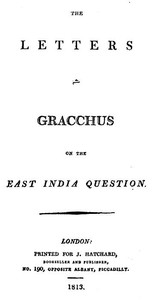
_EAST INDIA QUESTION_.

PRINTED FOR J. HATCHARD,

BOOKSELLER AND PUBLISHER,

NO. 190, OPPOSITE ALBANY, PICCADILLY.

Printed by S. GOSNELL, Little Queen Street, London.

The following Letters appeared in the MORNING POST, at the dates which are annexed to them. The impartial Reader will find in them a strong determination, to uphold the public rights of the Country, with respect to the India Trade; but he will not discover any evidence of a desire to lower the just, and well-earned honours, of THE EAST INDIA COMPANY, nor any symptom of a disposition hostile to their fair pretensions.

GENERAL VIEW OF THE EAST INDIA QUESTION.

_Tuesday, January 12, 1813._

The crisis, at which the affairs of the East India Company are now arrived, is one which involves the most important interests of the British Empire. It would be unnecessary to prove a proposition which is so universally acknowledged and felt. It has happened however, that, in our approaches towards this crisis, the Public understanding has been but little addressed upon the subject; so that the appeal which is now suddenly made to their passions and imaginations, finds them unprepared with that knowledge of the true circumstances of the case, which can alone enable them to govern those passions, and control those imaginations. Let us then endeavour to recover the time which has been lost, by taking a deliberate view of the circumstances which produce this crisis.

The crisis, is the proximity of the term which may conclude the East India Company's rights, to the exclusive trade with India and China, and to the powers of government now exercised by them over the Indian Empire.

The rights of the East India Company are two-fold; and have long been distinguished as, their _permanent_ rights, and their _temporary_ rights. Those rights are derived to them from distinct Charters, granted to them at different times by Parliament. By the former, they were created a _perpetual_ Corporate Society of Merchants, trading to India[1]. By the latter, they obtained, for a _limited period of time_, the exclusive right of trading with India and China, and of executing the powers of government over those parts of the Indian territory, which were acquired either by conquest or by negotiation. The Charter conveying the latter limited rights, is that which will expire in the course of the ensuing year 1814; on the expiration of which, the exclusive trade to the East will be again open to the British population at large, and the powers of the India Government will lapse in course to the Supreme Government of the British Empire, to be provided for as Parliament in its wisdom may judge it advisable to determine.

The renewal of an _expired_ privilege cannot be pursued upon a ground of _right_. The exclusive Charter of the Company is _a patent_, and their patent, like every other patent, is limited as to _its duration_. But though the patentee cannot allege a ground of right for the renewal of his patent, he may show such strong pretensions, such good claims in equity, such weighty reasons of expediency for its renewal, as may ensure its attainment. Such are the claims and the pretensions of the East India Company to a renewal of their Charter; and as such they have been promptly and cheerfully received, both by the Government and the country at large.

But the progress of society, during a long course of years, is of a nature to produce a considerable alteration in the general state of things; the state of things must, therefore, naturally be called into consideration, upon the expiration of the term of years which determines the exclusive Charter of the East India Company; in order to inquire, whether that Charter should be renewed precisely in the same terms, and with the same conditions, as before; or whether the actual state of public affairs demands, that some alteration, some modification, of terms and conditions, should be introduced into the Charter or System which is to succeed.

In twelve letters originally published in the Morning Post during January and February 1813, the pseudonymous Gracchus—identified as William Augustus Miles—addresses the approaching expiration of the East India Company's charter. The author frames the debate as a matter of public rights versus corporate privilege, insisting that the exclusive trade was never granted without reserve but always on a principle of bargain and covenant. The letters aim to supply the knowledge that, as Gracchus writes, the public has been left unprepared to govern their passions and control their imaginations.

The Crisis of Approaching Terms

Gracchus opens by identifying the crisis as the proximity of the term that may conclude the Company's exclusive trade and governmental powers. He distinguishes between the Company's permanent rights—derived from a charter creating them as a perpetual corporate society of merchants—and their temporary rights, granted for a limited period. The latter charter, set to expire in 1814, would revert the exclusive trade to the British population at large and cause the powers of Indian government to lapse to the Supreme Government. The author insists that renewal of an expired privilege cannot be pursued upon a ground of right, setting a legalistic tone that pervades the letters.

Bargain and Covenant as Governing Principle

Throughout the excerpts, Gracchus repeatedly returns to the idea that the exclusive trade has always been conceded on a principle of bargain and covenant, with a pecuniary advance by the Company to the Public as the condition for renewal. He warns both the Company and the Public to remember this compact. The author presents a compressed view of probable consequences under two scenarios: acceptance of the government's proposition or rejection. In the first case, the Company would preserve the entire China trade and retain control of India commerce; in the second, they would lose both and compel Parliament to place Indian patronage under different arrangements. The language is deliberately balanced, urging the Company not to drop the substance to pursue the shadow.

A Rhetoric of Deliberate View

Gracchus adopts a measured, almost judicial voice, repeatedly calling for a deliberate view of circumstances. He structures his arguments with numbered points, as seen in the five consequences for each scenario. The author's pseudonym—evoking the Roman reformer Gracchus—signals a populist stance, yet he explicitly denies any desire to lower the just honours of the Company. This tension between public advocacy and respect for established institutions defines the letters' rhetorical strategy. The excerpts show no personal attacks or emotional appeals; instead, Gracchus relies on logical enumeration and the language of mutual convenience.

Readers approaching these letters should attend to the way Gracchus balances competing claims: he upholds public rights while acknowledging the Company's fair pretensions. The numbered lists and conditional scenarios reward careful comparison. Because the excerpts are incomplete, the full range of Gracchus's arguments—particularly on China trade and territorial revenues—remains partially obscured. The letters are best read as a specimen of early nineteenth-century political pamphleteering, where legal and economic reasoning is deployed to influence a parliamentary decision.

Those old letters of Gracchus, arguing over trade and covenant, always made me think of how nations, like people, bargain with their own shadows. That quiet tension, the visible fraying of a promised contract, whispers through the pages of Behind the Mirrors: The Psychology of Disintegration at Washington — Reading Companion, too. A familiar ache of unraveling, felt across two centuries and one restless republic.

There are no reviews for this eBook.

0
0 out of 5 (0 User reviews )

Add a Review

Your Rating *
There are no comments for this eBook.

Reader reflection

How did this book work for you?

Your answers remain private and are stored only in this browser.

Your progress 0 / 10
1

How far have you progressed with this book?

2

Was reading this book enjoyable?

3

Is this a title you would suggest to others?

4

How demanding did the text feel?

Related eBooks