About 53 minutes
An Answer to a Question that Nobody thinks of, viz., But what if the Queen should Die? — Text and Context
Government
12,166 recorded words. 0 minutes difference from this book's estimate.
View Gutenberg source #36681
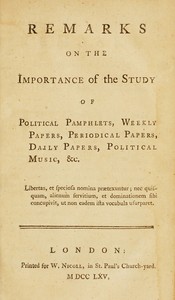
Before opening Remarks on the Importance of the Study of Political Pamphlets, Weekly Papers, Periodical Papers, Daily Papers, Political Music, &c. — Reading Notes, the edition data offers a quick orientation: 11,997 words, 53 min estimated reading time, and 3 detected text sections.
The text analysis averages about 42.5 words per sentence, while the detected sections provide another way to judge how the source is divided.
Project Gutenberg metadata also associates the work with “Great Britain -- Politics and government -- 1760-1820 -- Early works to 1800,” connecting these edition facts with the source record’s subject description.
Explore this collection
These alternatives are selected using recorded categories and estimated reading time.
About 53 minutes
Government
12,166 recorded words. 0 minutes difference from this book's estimate.
View Gutenberg source #36681About 53 minutes
Government
12,044 recorded words. 0 minutes difference from this book's estimate.
View Gutenberg source #49021About 47 minutes
Government
10,785 recorded words. 6 minutes difference from this book's estimate.
View Gutenberg source #54834Search stored excerpts and compare books → Choose by your preferences →
Choices use stored catalog measurements. Estimates vary with reading speed. A shared category is a catalog label, not a claim that two books have the same argument or literary quality.
Search reads excerpt text stored with this catalog and links to its associated Gutenberg record. The connection is stored in the site database; this tool does not recheck that every excerpt is word-for-word identical to that external record. Excerpt search does not cover every chapter and does not verify historical publication dates.
Catalog snapshot checked: 2026-09-26. Coverage: 90 public books, 90 available source excerpts.
Calculated from edition completeness, EPUB availability, text structure and catalogue metadata. Not a user rating.
Total of 100 points, scaled to a 2.5-5.0 range. Editions with an empty description or a missing EPUB file are not scored.
Public-domain source text
The source text is kept in the dedicated reader, separate from this catalogue record and its commentary.
The anonymous author of this 1765 pamphlet opens with a sweeping condemnation of 'impertinence' in conversation, pulpit, bar, and senate, then pivots to defend the humble pamphlet writer. The tone is ironic: the writer claims pamphlets can never be wholly useless, since a reader may toss one aside at the first line—unlike a tedious sermon or speech. This self-deprecating posture sets up a sustained argument that the study of political ephemera—weekly papers, daily papers, even 'Political Music'—is vital for a free people. The author draws on classical examples (Rome's fall) and recent conspiracies (Jesuits in France and Portugal) to warn against credulity, while simultaneously praising the 'generous and noble calls of liberty' found in the press. The work is as much a performance of rhetorical irony as a political treatise.
The pamphlet begins by defining 'impertinence' in social settings—the pert coxcomb, the solemn fop, the frothy declaimer—before exempting the pamphlet writer from this charge. The author argues that a pamphlet buyer is never compelled to purchase; if deceived by a title page, he has no right to complain. This legalistic framing subtly defends the genre against accusations of triviality. The writer then claims that no pamphlet is wholly useless, as it can always serve some purpose, unlike a conversation or sermon that merely tires the audience. This contrast between printed ephemera and live speech is a key structural device: the pamphlet is portable, dismissible, and therefore less offensive than the bore who monopolizes a room.
The author marshals examples from Roman history—Marius, Sylla, Catiline, Pompey, Caesar—to show how secret machinations of patricians and plebeians ruined the republic. These conspirators were all Romans, just as the Jesuits in France and Portugal were Frenchmen and Portuguese, and the plotters under Charles I, Charles II, and James II were Englishmen (with a few Scots). The point is that credulity, the 'daughter of Stupidity and Ignorance,' has destroyed many nations. The author urges readers not to shut their ears to 'the cries of the streets' nor turn away from 'the lamentations of the news-papers.' The press is presented as a corrective to the outward appearances of loyalty and virtue that mask conspiracy.
The author claims to have read almost every pamphlet and paper published in the last five years on political subjects, with 'equal delight and astonishment' at their wit and spirit. He then announces a recent discovery: the study of history, laws, treaties, and political systems is 'mere loss of time, and downright pedantry.' This is illustrated by a story about Montesquieu, who allegedly spent twenty-five years on two small volumes, dashed them against a wall, and only published because the wall returned them. The modern politician, by contrast, needs no learned dust; the direct road to political composition has been found. This satirical swipe at erudition serves to elevate the plain, immediate voice of the pamphlet over systematic knowledge.
The author warns against dismissing popular outcry as the 'counterfeit tears' or 'hired mourners' of faction. The groans and wailings in newspapers are not the snarling of ravenous faction or the braying of a deluded mob; they are 'the genuine voice of the venerable and sacred multitude,' neither provoked by private resentment nor bribed nor awed. This personification of the public as a single, noble entity contrasts with the earlier catalogue of impertinent speakers. The pamphlet thus oscillates between defending the common reader's judgment and satirizing the pretensions of learned politicians. The final appeal is to listen to the streets and papers—a democratic epistemology embedded in an ironic, learned frame.
Readers should approach this pamphlet as a layered performance: its surface argument for studying ephemera is undercut by its own learned allusions and ironic self-deprecation. The author's voice shifts between the humble scribbler and the erudite critic, making the work a specimen of the very genre it defends. Pay attention to how the writer uses classical and contemporary examples not as straightforward evidence but as rhetorical moves in a game of persuasion. The pamphlet rewards those who read it as both a political argument and a satire of political argument itself.
That 1765 pamphlet, with its quiet insistence on the plain voice of citizens, stayed with me through the dripping eaves. It made me think of how arguments echo down the years. Later, shelves yielded a Saratoga reply—a countersuit, really. Its patient unraveling felt familiar, like finding the other side of a conversation I'd started alone. A Review and Exposition, of the Falsehoods and Misrepresentations, of a Pamphlet Addressed to the Republicans of the County of Saratoga, Signed, "A Citizen" — A Closer Reading became that afternoon's quiet counterpart.
Answer a few questions and save a private reflection on this device.