About 429 minutes
Sketches in the House: The Story of a Memorable Session (1893) — Context and Discussion
Government
98,467 recorded words. 2 minutes difference from this book's estimate.
View Gutenberg source #14443
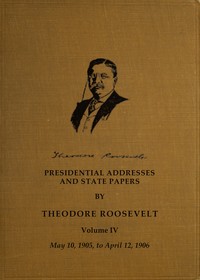
Before opening Presidential addresses and state papers, Volume 4 (of 7) — Background and Themes, the edition data offers a quick orientation: 98,030 words, 7 hr 7 min estimated reading time, and 59 detected text sections.
The text analysis averages about 32.1 words per sentence, while the detected sections provide another way to judge how the source is divided.
Project Gutenberg metadata also associates the work with “Roosevelt, Theodore, 1858-1919,” connecting these edition facts with the source record’s subject description.
Explore this collection
These alternatives are selected using recorded categories and estimated reading time.
About 429 minutes
Government
98,467 recorded words. 2 minutes difference from this book's estimate.
View Gutenberg source #14443About 425 minutes
Government
97,609 recorded words. 2 minutes difference from this book's estimate.
View Gutenberg source #74681About 408 minutes
Government
93,765 recorded words. 19 minutes difference from this book's estimate.
View Gutenberg source #20961Search stored excerpts and compare books → Choose by your preferences →
Choices use stored catalog measurements. Estimates vary with reading speed. A shared category is a catalog label, not a claim that two books have the same argument or literary quality.
Search reads excerpt text stored with this catalog and links to its associated Gutenberg record. The connection is stored in the site database; this tool does not recheck that every excerpt is word-for-word identical to that external record. Excerpt search does not cover every chapter and does not verify historical publication dates.
Catalog snapshot checked: 2026-09-26. Coverage: 90 public books, 90 available source excerpts.
Calculated from edition completeness, EPUB availability, text structure and catalogue metadata. Not a user rating.
Total of 100 points, scaled to a 2.5-5.0 range. Editions with an empty description or a missing EPUB file are not scored.
Public-domain source text
The source text is kept in the dedicated reader, separate from this catalogue record and its commentary.
Theodore Roosevelt's fourth volume of addresses and state papers captures a president in constant motion, both geographically and rhetorically. Between May and October 1905, he spoke at merchants' clubs, college graduations, Confederate reunions, and naval vessels, tailoring his message to each audience while maintaining a consistent emphasis on duty, character, and the subordination of material gain to higher principles. The speeches are marked by a direct, conversational tone—Roosevelt frequently addresses his listeners as "my hosts" or "my fellow laymen"—and by a strategic use of historical analogy, as when he traces the evolution of law from a time when "about five per cent of any given number of children born in England were punished by hanging."
Across the volume, Roosevelt shifts register with notable precision. Before the Merchants' Club in Chicago, he adopts the language of commerce and national growth; at Holy Cross College, he speaks of moral and spiritual foundations. At the unveiling of a statue of General Slocum, he invokes the Civil War as a shared sacrifice, addressing "you men of the blue and men of the gray" with equal honor. This adaptability is not mere politeness—it reflects a deliberate strategy to connect abstract principles to the lived experience of each audience. Roosevelt often frames his remarks around a single, concrete occasion—a statue unveiling, a cup presentation, a consistory's hospitality—using the event as a springboard into broader commentary on citizenship and governance.
In his Little Rock luncheon address, Roosevelt offers an extended critique of the legal profession from a self-described layman's perspective. He argues that the law has not kept pace with social change, retaining safeguards designed for an era when "the government acted as a plaintiff" and individuals needed protection from state power. Now, he contends, "the public has by no means the chance it ought to have" against corporate and individual wrongdoing. Roosevelt's language here is careful—he speaks "merely to my fellow laymen" and invites correction "from Gamaliel"—but his point is sharp: lawyers must treat their profession as a means to public service, not an end. This passage exemplifies his willingness to engage with technical subjects while maintaining an accessible, almost colloquial tone.
Throughout the volume, Roosevelt returns to a central dichotomy: material well-being as a foundation, and moral or spiritual life as the superstructure. At the Little Rock luncheon, he tells Civil War veterans that they "treated material considerations as dross to be cast aside" when duty called. At Chautauqua and in addresses to educational associations, he warns against valuing prosperity alone. This motif is not merely rhetorical—it structures his argument that national greatness depends on character, not wealth. Roosevelt's diction reinforces the point: he uses words like "dross," "altar," and "privilege" to elevate sacrifice above comfort, and he frequently contrasts the temporary with the enduring, urging listeners to build "the superstructure of the moral and spiritual higher life."
Roosevelt's speeches are studded with direct appeals to his listeners, often naming individuals or groups: "Mr. Toastmaster; Judge Rose; My Hosts." He thanks hosts, acknowledges local dignitaries, and references specific organizations—the Arkansas Consistory, the Iroquois Club, the Grand Army of the Republic. This practice creates a sense of immediacy and mutual respect. He also uses rhetorical questions and self-deprecation, as when he says, "I am speaking before Gamaliel, and shall expect correction." Such moves disarm potential critics and invite the audience into a shared inquiry. The cumulative effect is a portrait of a president who treats each speech as a conversation, not a proclamation, and who expects his listeners to engage actively with the ideas he presents.
Readers approaching this volume should attend to the interplay between occasion and argument. Roosevelt rarely delivers a generic address; each speech responds to its setting—a college commencement, a veterans' reunion, a chamber of commerce luncheon—while advancing a coherent set of convictions about duty, law, and national character. The volume rewards attention to his shifts in tone and his willingness to challenge his audience's assumptions, whether about the legal system or the meaning of prosperity. It offers a window into how a president used public speech to educate, persuade, and unify a diverse nation.
Reading this fourth volume of Roosevelt’s speeches, I felt that old ache for plainspoken duty, and it put me in mind of another quiet study of public character: The Mirrors of Downing Street Some Political Reflections by a Gentleman with a Duster — Inside the Classic. Both seem to catch statesmen mid-gesture, their best intentions fading into the hush of history.
Answer a few questions and save a private reflection on this device.