About 497 minutes
Ulster's Stand For Union — Reading Companion
Government
114,150 recorded words. 0 minutes difference from this book's estimate.
View Gutenberg source #14326
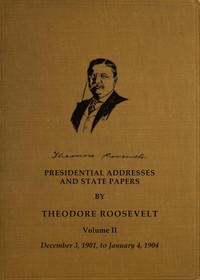
The source record for Presidential addresses and state papers, Volume 2 (of 7) — Themes and Context measures this digital text at 114,201 words, 8 hr 17 min estimated reading time, and 20 detected text sections.
The text analysis averages about 33.0 words per sentence, while the detected sections provide another way to judge how the source is divided.
Project Gutenberg metadata also associates the work with “Roosevelt, Theodore, 1858-1919,” connecting these edition facts with the source record’s subject description.
Explore this collection
These alternatives are selected using recorded categories and estimated reading time.
About 497 minutes
Government
114,150 recorded words. 0 minutes difference from this book's estimate.
View Gutenberg source #14326About 502 minutes
Government
115,457 recorded words. 5 minutes difference from this book's estimate.
View Gutenberg source #10693About 482 minutes
Government
110,656 recorded words. 15 minutes difference from this book's estimate.
View Gutenberg source #20109Search stored excerpts and compare books → Choose by your preferences →
Choices use stored catalog measurements. Estimates vary with reading speed. A shared category is a catalog label, not a claim that two books have the same argument or literary quality.
Search reads excerpt text stored with this catalog and links to its associated Gutenberg record. The connection is stored in the site database; this tool does not recheck that every excerpt is word-for-word identical to that external record. Excerpt search does not cover every chapter and does not verify historical publication dates.
Catalog snapshot checked: 2026-09-26. Coverage: 90 public books, 90 available source excerpts.
Calculated from edition completeness, EPUB availability, text structure and catalogue metadata. Not a user rating.
Total of 100 points, scaled to a 2.5-5.0 range. Editions with an empty description or a missing EPUB file are not scored.
Public-domain source text
The source text is kept in the dedicated reader, separate from this catalogue record and its commentary.
Theodore Roosevelt's second volume of presidential addresses and state papers, covering 1903, presents the reader with a direct record of his public rhetoric and policy arguments. Unlike a memoir or retrospective analysis, these are the words delivered to specific audiences—from navy yard workers in Bremerton to the Union League Club in San Francisco—preserving the immediacy of his speaking style and the issues he chose to emphasize. The catalog subjects list Roosevelt and United States politics and government (1901–1909), but the excerpts reveal a narrower focus: naval readiness, the Monroe Doctrine, and the practical challenges of manning a growing fleet. The volume's structure, grouping speeches by date and occasion, allows the reader to trace how Roosevelt adapted his message to different venues while maintaining core themes.
The longest excerpt in the available text is a sustained argument for naval expansion, delivered as part of a message to Congress. Roosevelt frames the navy as both a practical necessity and a guarantor of peace: "A good navy is not a provocative of war. It is the surest guaranty of peace." This claim is supported by detailed appeals for funding—not just for ships but for "prizes to encourage the gun crews" and "perfecting an intelligent system" of gunnery practice. The speech reveals a president who is comfortable with technical specifics: he discusses the need for "a thousand additional officers," the strain on lieutenants and junior grades, and the impossibility of improvising a crew. The Monroe Doctrine is invoked as a reason for naval strength, but the argument is grounded in logistics rather than ideology. Readers interested in the intersection of military policy and political persuasion will find a case study in how an executive branch leader uses a formal address to justify budget priorities and organizational reforms.
The table of contents lists dozens of addresses delivered at dedications, banquets, university ceremonies, and religious services. These occasional speeches—such as the remarks at the dedication of the Navy Memorial Monument in San Francisco or the consecration of Grace Memorial Reformed Church in Washington—show Roosevelt performing the role of national spokesman for civic and patriotic values. The range of venues is striking: from the Arctic Brotherhood in Seattle to the Saengerfest in Baltimore, he adapts his tone to each audience while returning to themes of duty, national unity, and historical continuity. The speech at the Lincoln Monument in Springfield, for instance, likely draws on the symbolic weight of that site. These texts offer material for studying how early twentieth-century presidential rhetoric operated outside the formal channels of messages to Congress, blending policy advocacy with ceremonial affirmation. The volume preserves the ephemeral genre of the public address as a tool of governance.
Interspersed with the speeches are letters and statements that provide a different register of presidential activity. The excerpts include correspondence about the appointment of Dr. Crum, a statement to the American Federation of Labor, and a letter to Governor Durbin. These documents shift from the public stage to the administrative and political negotiations that underpin policy. The letter to Secretary Cortelyou, for example, suggests internal deliberation about executive action. The statement to the American Federation of Labor indicates direct engagement with organized labor, a constituency Roosevelt courted and challenged. Unlike the set-piece speeches, these texts are shorter, more direct, and often reactive. They reveal the president managing relationships with individuals and organizations, and they remind the reader that the volume is not merely a collection of oratory but a record of governance. The inclusion of such material enriches the portrait of Roosevelt as an executive who used multiple communicative channels to advance his agenda.
This volume is best approached as a primary source for the study of presidential rhetoric and early twentieth-century American political culture. Readers should attend to the specific occasions, audiences, and textual variations across the speeches, rather than seeking a unified policy statement. The correspondence sections offer a counterpoint to the public addresses, revealing the less polished but equally strategic side of Roosevelt's communication. For those interested in the history of the presidency, the navy, or Progressive Era politics, these papers provide direct evidence of how one president argued, negotiated, and governed in a single year.
Build a private reading journal entry for this title.