
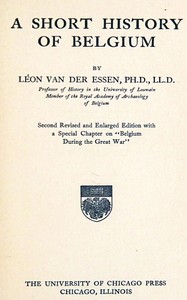
A short history of Belgium by Léon van der Essen
If you asked most people to describe Belgium's history, you might get a shrug. Léon van der Essen, a respected Belgian historian writing in the early 20th century, set out to fix that. His 'A Short History of Belgium' is exactly what it says on the tin: a concise, chronological walk through the events that shaped a nation often overlooked.
The Story
The book doesn't follow a single character, but the main character is Belgium itself. Van der Essen starts way back with the Roman province of Gallia Belgica and moves steadily forward. He shows how the region we now call Belgium was, for most of its existence, a collection of powerful duchies and counties like Flanders and Brabant, prized for their wealth but constantly fought over by foreign rulers. It was part of the Burgundian Netherlands, then ruled by Spain, then Austria, then France, and then forced into a union with the Netherlands. The core narrative is the long, difficult struggle for independence, which was finally won in 1830. The book then traces the young nation's growing pains, its industrialization, colonial venture in the Congo, and the immense challenges of the First World War, which was raging as van der Essen wrote.
Why You Should Read It
What makes this history special is its perspective. Van der Essen isn't a detached observer; he's a patriot writing to explain and defend his country's right to exist. You can feel his pride in Belgium's cultural achievements and his sober recognition of its geopolitical vulnerabilities. He cuts through complexity without oversimplifying. You won't get lost in dates and treaties; instead, you get a clear sense of cause and effect. He makes you understand why the linguistic divide between French and Dutch speakers is such a deep-rooted issue, and how Belgium's location as a 'crossroads of Europe' has been both a curse and, occasionally, a blessing. It's history with a point of view, which makes it much more engaging than a neutral textbook.
Final Verdict
This is the perfect book for a curious traveler planning a trip to Brussels or Bruges, or for anyone who enjoys European history but has gaps in their knowledge of the Low Countries. It's also great for readers who might be intimidated by massive, door-stopper histories. Van der Essen delivers a complete, compelling story in a very manageable package. While some details are naturally dated (the book ends before WWII), the foundation it provides is rock solid. Think of it as the essential primer—the story of how a buffer zone between giants became a nation, told with clarity and quiet passion by someone who believed deeply in its story.
This text is dedicated to the public domain. Share knowledge freely with the world.
Linda Gonzalez
2 months agoRight from the opening paragraph, the transition between theoretical knowledge and practical application is seamless. This should be on the reading list of every serious professional.
Patricia Thompson
8 months agoIf you're tired of surface-level information, it addresses the common misconceptions in a very professional manner. An excellent example of how quality digital books should be formatted.
Paul Davis
1 year agoThis book was worth my time since the flow of the text seems very fluid. I learned so much from this.
Lucas Williams
7 months agoAfter finishing this book, the arguments are well-supported by credible references. I learned so much from this.






David Smith
9 months agoThis was exactly the kind of deep dive I was searching for, the transition between theoretical knowledge and practical application is seamless. This has become my go-to guide for this specific topic.