
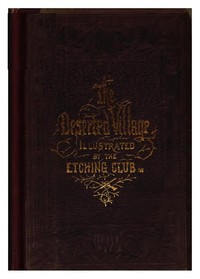
The Deserted Village by Oliver Goldsmith
Let's talk about a poem that feels more like a ghost story for a community. 'The Deserted Village' is Oliver Goldsmith's famous 1770 work, and it's exactly what the title says: a lament for a lost home.
The Story
The poem doesn't have a plot with twists and turns. Instead, it's a guided tour through memory. The speaker returns to Auburn, the village of his youth, only to find it desolate. Where there was once laughter from the school, the bustle of the tavern, and the busy work of farmers, there is now silence and overgrown weeds. He paints vivid pictures of the people who used to live there—the kind-hearted preacher, the stern but fair schoolmaster, the cheerful alehouse host. One by one, he shows us their empty places. The cause of this desertion? The poem points a finger at the 'tyrant' of wealth and luxury. As large estates grew and land was enclosed for private profit, the common villagers were forced out, leaving for uncertain futures in crowded cities or across the sea in America. The story is the slow, painful erasure of a whole world.
Why You Should Read It
You should read it because it's deeply human. Even though it was written 250 years ago, the feeling it describes is timeless. We've all seen places change beyond recognition, or felt nostalgia for a time that's gone. Goldsmith makes you feel that loss in your bones. His portraits of the villagers are so warm and specific—you can almost see the schoolmaster's stern look or hear the blacksmith's hammer. The poem argues that something valuable—community, simplicity, a connection to the land—was sacrificed for progress and money. It asks a question we're still wrestling with today: what do we lose when we only chase growth?
Final Verdict
This book is perfect for anyone who loves poetry that tells a real story, or for readers interested in history who want to feel the human cost of the Industrial Revolution. It's also great if you just enjoy beautiful, melancholic writing. It's not a light read, but it's a relatively short one, and its emotional punch is powerful. If you've ever looked at an old photo of your hometown and sighed, 'The Deserted Village' will speak directly to you.
Legal analysis indicates this work is in the public domain. It is now common property for all to enjoy.
George Moore
8 months agoI started reading this with a critical mind, the visual layout and supporting data make the reading experience very smooth. This is a solid reference for both beginners and experts.
Nancy Thompson
3 months agoThe clarity of the introduction set high expectations, and the author’s unique perspective adds a fresh layer to the discussion. This adds significant depth to my understanding of the field.
Donald Thomas
1 year agoThis was exactly the kind of deep dive I was searching for, the formatting on mobile devices is surprisingly crisp and clear. It’s hard to find this much value in a single source these days.
Nancy Rodriguez
9 months agoGreat digital experience compared to other versions.



Linda Gonzalez
4 months agoI've gone through the entire material twice now, and the language used is precise without being overly academic or confusing. A trustworthy resource that I'll keep in my digital library.