
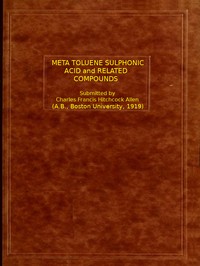
Meta toluene sulphonic acid and related compounds by C. F. H. Allen
Let's be clear from the start: this is not a beach read. Meta Toluene Sulphonic Acid and Related Compounds is a specialized scientific text from 1955. There are no characters, no plot twists in the traditional sense. Its structure is methodical and academic. But if you adjust your expectations, there's a unique kind of narrative here.
The Story
The 'story' is the life of a molecule. Author C.F.H. Allen, a respected chemist, acts as a biographer for meta-toluene sulphonic acid (often abbreviated MTSA). He systematically documents its origins: how to make it. He details its physical personality: what it looks like, how it behaves. The heart of the book is a catalog of its relationships—how it reacts with a huge array of other chemicals. Finally, Allen explores its purpose, listing its industrial applications as a catalyst and intermediate in creating other, more complex substances. The 'conflict' is the human struggle to fully characterize and master this tool, mapping its potential from theory to practical factory-floor use.
Why You Should Read It
I found this book strangely humbling and impressive. It represents a monument to deep, specific expertise. In our age of infinite, shallow information, here is a work that aims to say everything known about one hyper-specific topic. It’s a snapshot of mid-20th century chemical science, full of precise data and careful observations. Reading it, you get a profound appreciation for the incremental, painstaking work that built our material world. The plastic in your phone, the dye in your clothes, the medicine in your cabinet—they all rest on a foundation of knowledge compiled in books just like this one. Allen’s clear, no-nonsense prose, while technical, has a kind of quiet confidence and clarity that is itself admirable.
Final Verdict
This is a niche book for niche interests. It's perfect for history of science enthusiasts who want to handle a primary source. It's great for practicing chemists curious about the foundational literature of their field. It might also appeal to anyone fascinated by 'obscure' knowledge or the aesthetics of old technical manuals. If you love the smell of old paper and the sight of dense, meaningful tables, you might just fall for it. For the general fiction reader? Probably not. But if you've ever wondered what fills the pages of a highly specialized scientific book, this is a pristine and authoritative example. It’s less of a story and more of a monument, and sometimes that's just as interesting.
This title is part of the public domain archive. You can copy, modify, and distribute it freely.
Mary Lopez
8 months agoExtremely helpful for my current research project.
Mary White
1 year agoIt effectively synthesizes complex ideas into a coherent whole.
Patricia Anderson
1 year agoIt effectively synthesizes complex ideas into a coherent whole.
Ashley Thomas
1 year agoRight from the opening paragraph, the cross-referencing of different chapters makes it a great study tool. A refreshing and intellectually stimulating read.






Sarah Wilson
4 months agoThis digital copy caught my eye due to its reputation, the bibliography and references suggest a high level of research and authority. Top-tier content that deserves more recognition.