About 631 minutes
The Life of Cardinal Wolsey — Text and Context
Government
144,977 recorded words. 6 minutes difference from this book's estimate.
View Gutenberg source #54043
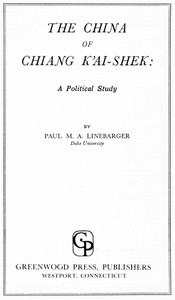
The source record for The China of Chiang K'ai-Shek: A Political Study — Background and Themes measures this digital text at 146,290 words, 10 hr 37 min estimated reading time, and 23 detected text sections.
The text analysis averages about 22.3 words per sentence, while the detected sections provide another way to judge how the source is divided.
Project Gutenberg metadata also associates the work with “China -- Politics and government -- 1912-1949,” connecting these edition facts with the source record’s subject description.
Explore this collection
These alternatives are selected using recorded categories and estimated reading time.
About 631 minutes
Government
144,977 recorded words. 6 minutes difference from this book's estimate.
View Gutenberg source #54043About 695 minutes
Government
159,812 recorded words. 58 minutes difference from this book's estimate.
View Gutenberg source #69971About 576 minutes
Government
132,409 recorded words. 61 minutes difference from this book's estimate.
View Gutenberg source #38014Search stored excerpts and compare books → Choose by your preferences →
Choices use stored catalog measurements. Estimates vary with reading speed. A shared category is a catalog label, not a claim that two books have the same argument or literary quality.
Search reads excerpt text stored with this catalog and links to its associated Gutenberg record. The connection is stored in the site database; this tool does not recheck that every excerpt is word-for-word identical to that external record. Excerpt search does not cover every chapter and does not verify historical publication dates.
Catalog snapshot checked: 2026-09-26. Coverage: 90 public books, 90 available source excerpts.
Calculated from edition completeness, EPUB availability, text structure and catalogue metadata. Not a user rating.
Total of 100 points, scaled to a 2.5-5.0 range. Editions with an empty description or a missing EPUB file are not scored.
Public-domain source text
The source text is kept in the dedicated reader, separate from this catalogue record and its commentary.
Linebarger opens his study with an extensive acknowledgments section that reads like a diplomatic roster: Generalissimo and Mme. Chiang, cabinet ministers, military officers, and foreign correspondents are all thanked. This list is not mere courtesy—it signals the author's method. He gained access to the highest levels of the Nationalist government, and his analysis draws on firsthand interviews and documents rather than distant observation. The tone is that of a political scientist writing for a policy audience, but the voice is personal, even confiding, as when he notes that “political and military conditions forbid mention of some of the persons to whom I am most indebted.”
Linebarger’s narrative voice shifts between detached academic and engaged participant. He refers to “my student days together at the Johns Hopkins” with Chinese friends, yet elsewhere deploys jargon like “extra-political pressure” and “Paretians.” This duality gives the text an unusual texture: the reader is never sure whether they are reading a policy brief or a memoir. The acknowledgments reveal a network of personal relationships that underpin the study’s authority, but Linebarger does not dwell on his own role. Instead, he lets the list of names—Sun K'ê, H. H. Kung, Chou En-lai’s colleague Ch'in Po-k'u—imply the breadth of his sources. The effect is a work that feels both intimate and institutional.
The prose moves in long, dense paragraphs that accumulate names, organizations, and acronyms: the People’s Foreign Relations Association, the China Branch of the International Peace Campaign, the American League for Peace and Democracy. This piling-on creates a sense of overwhelming complexity, mirroring the fractured political landscape Linebarger describes. Yet within these blocks, he inserts sharp observations: “There is no Chinese C.I.O., nor A. F. of L., but there is also no National Association of Manufacturers.” The pace slows when he discusses specific groups—Christian missions, the Y.M.C.A.—and quickens when he turns to theoretical frameworks like the “double set of barriers” every government faces. This alternation between concrete reporting and abstract analysis gives the text a rhythm that rewards careful reading.
Two motifs recur throughout the excerpts: the idea of political action through “casual, untraceable patterns of personal relationships,” and the metaphor of government operating within a “corridor” bounded by the needs of the governed and the compensation of the governors. Linebarger returns to these images to explain how power actually functions in wartime China—not through formal institutions but through “scurrilous, politically vile, selfish advantages” balanced by “concrete improvement.” He is skeptical of ideological labels, noting that the International Peace Campaign in China had “no trace of defeatism” despite its leftist associations elsewhere. This insistence on local context, on how Western categories fail to capture Chinese realities, is a thread that runs through the work.
Readers should approach this study as a document of its moment—1942, when the outcome of the war was uncertain and the Nationalist government was still the legitimate face of China to the world. Linebarger’s closeness to his subjects is both a strength and a limitation: he reports what his informants told him, but the reader must weigh that against other accounts. The book is best read alongside works by the journalists he thanks, such as Theodore White, to triangulate the picture of a regime in crisis.
Those old Chungking interviews in The China of Chiang K'ai-Shek always reminded me of a certain fragile pamphlet, An Answer to a Question that Nobody thinks of, viz., But what if the Queen should Die? — Text and Context, for both whisper of succession’s quiet dread. Each assumes a world that outlives its careful plans, and I have held that shiver many times.
Build a private reading journal entry for this title.