
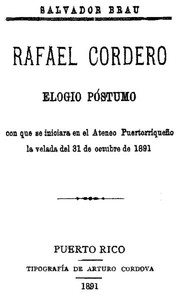
Rafael Cordero: Elogio Póstumo by Salvador Brau
Published in 1893, Salvador Brau's "Rafael Cordero: Elogio Póstumo" is a unique piece of writing. It's not a novel or a standard biography. The title translates to "Posthumous Praise," and that's exactly what it sets out to be: a formal, public tribute. But in doing so, it accidentally becomes something else—a fascinating historical document and a quiet act of rebellion.
The Story
There isn't a traditional plot. Instead, Brau builds a portrait. He tells us about Rafael Cordero, a cigar maker by trade and a teacher by calling. In the early 1800s in San Juan, Puerto Rico, Cordero opened a humble school in his home. He taught reading, writing, math, and religion to any child who showed up, asking for no payment. His students were both the children of wealthy families and the poor, including enslaved and free Black children. Brau details Cordero's simple life, his deep religious faith, his unwavering dedication, and the profound respect he earned from all corners of society. The "story" is the argument Brau is making: that this man's life was a monumental example of charity and civic virtue that deserved permanent recognition.
Why You Should Read It
You should read it because it feels urgent, even today. Brau was a respected historian and intellectual of his time. By writing this formal elogio, he was officially inserting Cordero into the cultural record. Reading between the lines, you can feel his frustration. He's saying, "How have we not already built statues for this man?" The book is a powerful look at how history gets made—and who gets left out. Cordero himself emerges as a beautifully simple figure: not a revolutionary firebrand, but a man whose daily acts of kindness and fairness were, in their own way, radically inclusive. It makes you wonder about all the other "Rafael Corderos" whose stories were never written down.
Final Verdict
This is a short, dense read, more of an essay than a book. It's perfect for anyone interested in the hidden figures of Caribbean history, in stories of education, or in seeing how a society talks about its heroes. It's also great for readers who enjoy primary sources—you're getting the perspective of a 19th-century Puerto Rican thinker directly. If you're looking for a fast-paced narrative, this isn't it. But if you want a thoughtful, impactful hour of reading that will stick with you, Brau's tribute to the humble teacher is profoundly rewarding.
This historical work is free of copyright protections. You do not need permission to reproduce this work.
James Miller
7 months agoThis was exactly the kind of deep dive I was searching for, the way the author breaks down the core concepts is remarkably clear. Finally, a source that prioritizes accuracy over hype.
Donald Harris
8 months agoAs someone working in this industry, I found the insights very accurate.
Paul Martinez
1 year agoAfter a thorough walkthrough of the table of contents, the chapter on advanced strategies offers insights I haven't seen elsewhere. Thanks for making such a high-quality version available.
James Rodriguez
3 months agoThis digital copy caught my eye due to its reputation, the author manages to bridge the gap between theory and practice effectively. This is a solid reference for both beginners and experts.
Joseph Smith
7 months agoThis was exactly the kind of deep dive I was searching for, the clarity of the writing makes even the most dense sections readable. I am looking forward to the author's next publication.