
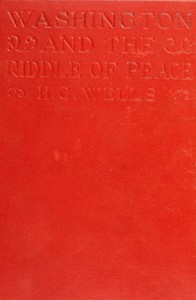
Washington and the Riddle of Peace by H. G. Wells
Let's be clear: this isn't a novel. If you're looking for the sci-fi adventures of H.G. Wells, this is a different beast. Washington and the Riddle of Peace is his non-fiction plea to the world, written in 1922. The world had just survived the 'war to end all wars,' and everyone was scrambling to prevent another one. Wells believed the old ways of diplomacy and secret treaties were a recipe for disaster.
The Story
The 'story' is Wells's own mission. He travels to Washington, D.C., the heart of a rising world power, and uses it as a stage. He argues that peace isn't something that just happens; it has to be built, like a machine or a society. His big idea? A new 'world state.' He wants nations to give up some of their solo power to a central, open, and scientific global authority that would manage resources, settle disputes, and make war obsolete. He tears into the failures of the League of Nations, which he saw as weak and outdated. The book is his detailed, sometimes technical, and always fiery proposal for what should replace it.
Why You Should Read It
You read this for Wells himself. His voice jumps off the page—impatient, brilliant, and genuinely worried. He's not a cold politician; he's a writer who saw the horror of war and used every tool he had to try and fix it. His arguments about media, education, and the need for a shared global story feel surprisingly modern. It's fascinating to see which of his predictions hit the mark and which seem wildly optimistic. More than anything, it captures a specific kind of hope—the raw, post-catastrophe belief that if we're smart enough, we can engineer a better system.
Final Verdict
This is for the curious reader, not the casual one. Perfect for history buffs who want to feel the intellectual turbulence after WWI, fans of Wells who want to see his mind tackle a real-world problem, or anyone interested in the long history of ideas about global cooperation. It's a challenging, opinionated, and deeply human document. Don't expect a neat narrative; expect to have a one-sided conversation with a passionate, frustrated, and hopeful genius about the biggest question there is.
This content is free to share and distribute. Feel free to use it for personal or commercial purposes.
Nancy Wilson
2 years agoThis book was worth my time since the atmosphere created is totally immersive. Exceeded all my expectations.
Edward Jackson
1 year agoFive stars!
Elizabeth Walker
1 year agoWithout a doubt, the atmosphere created is totally immersive. Highly recommended.
Elijah Jackson
1 year agoAfter hearing about this author multiple times, it provides a comprehensive overview perfect for everyone. I learned so much from this.
Edward Martin
1 year agoThe formatting on this digital edition is flawless.