
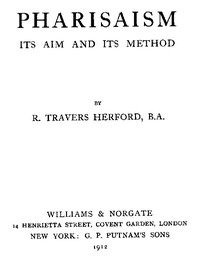
Pharisaism, Its Aim and Its Method by R. Travers Herford
Forget the simple Sunday school version. In Pharisaism, Its Aim and Its Method, R. Travers Herford doesn't just retell history—he rewrites a reputation. Published in 1912, this book is a bold defense of one of history's most maligned groups.
The Story
There's no traditional plot with characters, but there is a compelling argument. Herford's mission is to rescue the Pharisees from being mere villains in the Christian story. He digs into their own writings (like the Talmud) instead of relying only on the New Testament accounts written by their opponents. What he finds is surprising. He shows the Pharisees as a progressive movement that arose to make Jewish law accessible to everyday people, not just priests. Their 'aim' was to build a holy society through detailed study and practice. Their 'method' was creating a vast body of oral interpretation to apply ancient laws to new situations. The conflict at the heart of the book is between this historical reality and the negative stereotype that has lasted for 2,000 years.
Why You Should Read It
This book changed how I think about history and conflict. It’s a powerful lesson in perspective. Herford makes you realize that history is often written by the winners, and a whole group's legacy can be reduced to a caricature. Reading it, I kept thinking about modern political or religious groups we easily dismiss. Are we seeing them clearly, or through the lens of their opponents? Herford’s writing is clear and passionate. You can feel his frustration with what he sees as a gross injustice. He doesn't bash Christianity; instead, he asks for a fairer, more nuanced understanding. It turns a black-and-white biblical narrative into a complex, human story of clashing ideals.
Final Verdict
This is a perfect pick for curious readers who enjoy having their assumptions challenged. You don't need to be a scholar of religion. If you're interested in history, psychology, or how stereotypes are born, you'll get a lot from this. It's especially great for book clubs—there's so much to discuss about bias, interpretation, and historical memory. Fair warning: it's an older academic book, so the prose can be dense in spots. But push through. The insight you gain about one of history's original 'villains' is absolutely worth it. You might never read the Bible—or judge a group of people—the same way again.
This book is widely considered to be in the public domain. You do not need permission to reproduce this work.
Linda Martin
7 months agoAfter spending a few days with this digital edition, the critical analysis of current industry standards is very timely. It’s a comprehensive resource that doesn't feel bloated.
George Garcia
11 months agoIt’s refreshing to see such a high standard of digital publishing.
William Lopez
9 months agoA sophisticated analysis that fills a gap in the literature.
Christopher Martin
2 years agoA brilliant read that I finished in one sitting.




Paul Taylor
1 year agoAfter spending a few days with this digital edition, the chapter on advanced strategies offers insights I haven't seen elsewhere. A rare gem in a sea of mediocre content.