
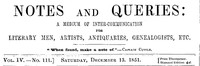
Notes and Queries, Vol. IV, Number 111, December 13, 1851 by Various
Let's be clear: Notes and Queries is not a novel. It's not even a single non-fiction book. This volume is a snapshot—one weekly issue of a magazine that was a cultural phenomenon in Victorian Britain. Think of it as a cross between a scholarly forum, a community bulletin board, and the early version of a 'Ask Historians' subreddit.
The Story
There's no traditional plot. Instead, the 'story' is the unfolding conversation. Each issue was packed with short entries from readers. Someone would pose a question—'What is the earliest known use of the word 'quiz'?' or 'Can anyone verify this local legend about a haunted inn?'—and then others would write in with answers, corrections, or their own related queries. This particular issue from December 1851 is a random slice of that endless dialogue. You might find a serious investigation into heraldic symbols next to a debate about the proper way to preserve ancient manuscripts, followed by a request for the full lyrics of a half-remembered folk song. The 'characters' are the correspondents themselves, identified often only by initials or pen names, all united by a shared, voracious curiosity.
Why You Should Read It
I love this because it completely shatters the stuffy image of the Victorian era. These people were nerds, in the best possible way. They were obsessed with folklore, word origins, local history, and odd artifacts. Reading their exchanges, you see the process of history being made, not from the top down by kings and generals, but from the ground up by vicars, lawyers, antiquarians, and just plain curious folks. The tone is surprisingly modern—sometimes earnest, sometimes snippy, often funny. You get the sense of a real community forming through print, building knowledge together. It’s humble, fascinating, and deeply human.
Final Verdict
This is perfect for history lovers who are tired of grand narratives and want to see the past in its messy, everyday detail. It’s for anyone who enjoys obscure facts, etymology, or folklore. If you like the idea of 'slow journalism' or the collaborative spirit of the internet, you’ll find its 19th-century ancestor here. It’s not a page-turner in the usual sense, but it is an incredibly compelling browse. Dip in for ten minutes and you’ll be transported.
This book is widely considered to be in the public domain. Feel free to use it for personal or commercial purposes.



Kevin King
4 months agoEssential reading for students of this field.