
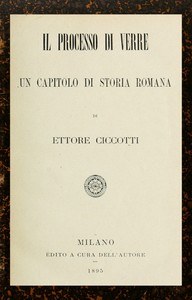
Il processo di Verre : Un capitolo di storia romana by Ettore Ciccotti
Ettore Ciccotti's book takes us back to a single, explosive year in Roman history: 70 BC. The stage is set in a courtroom, but the crime scene is the entire island of Sicily.
The Story
Cicero, a young lawyer not yet the famous statesman he would become, takes on the case of a lifetime. His opponent is Gaius Verres, the former governor of Sicily, who is accused of breathtaking corruption. For three years, Verres didn't just govern the island; he plundered it. He stole priceless statues and paintings from temples and homes. He invented taxes to line his pockets and let crimes go unpunished if the price was right. The Sicilians, pushed to their limit, finally demanded justice.
Cicero's task was monumental. He had to gather evidence, convince frightened witnesses to testify, and argue against powerful senators who were friends with Verres. The trial was a public spectacle, and Cicero used it not just to condemn one man, but to expose a whole system that allowed such behavior. The book walks us through this high-stakes legal battle, showing how Cicero's brilliant strategy and fiery speeches turned the tide of public opinion.
Why You Should Read It
What grabbed me about this story is how familiar it feels. You swap out the togas for suits, and it's a story you might see on the news today. It's about accountability, the abuse of power, and the courage it takes to stand up to a well-connected system. Ciccotti doesn't present Cicero as a perfect hero, but as a sharp, determined figure seizing a pivotal moment. Verres isn't a cartoon villain, but a chilling example of absolute power corrupting absolutely.
You get a real sense of the tension in that Roman forum. Will the evidence be enough? Will the political machine protect its own? It's history that reads with the pace of a legal thriller.
Final Verdict
This is a perfect pick for anyone who loves historical true crime or political dramas. If you enjoyed books like SPQR by Mary Beard but want to zoom in on one gripping, character-driven event, you'll love this. It's also great for readers who think they don't like history, because it focuses on human drama over dusty dates. You come away understanding a crucial moment that shaped Cicero's career and tested the soul of the Roman Republic. A fascinating, page-turning look at a ancient scandal that still echoes today.
This content is free to share and distribute. It is available for public use and education.
Jennifer Moore
1 month agoWhile browsing through various academic sources, the clarity of the writing makes even the most dense sections readable. Simple, effective, and authoritative – what else could you ask for?







John Jones
9 months agoMy first impression was quite positive because the chapter on advanced strategies offers insights I haven't seen elsewhere. Thanks for making such a high-quality version available.